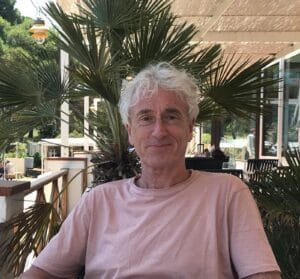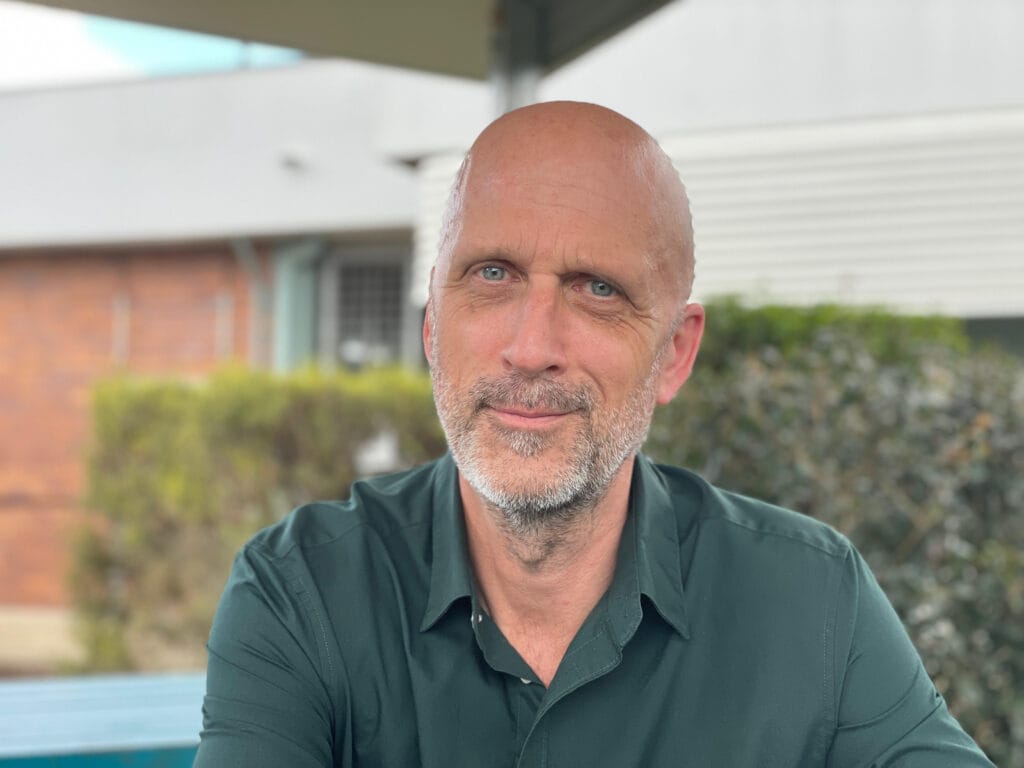
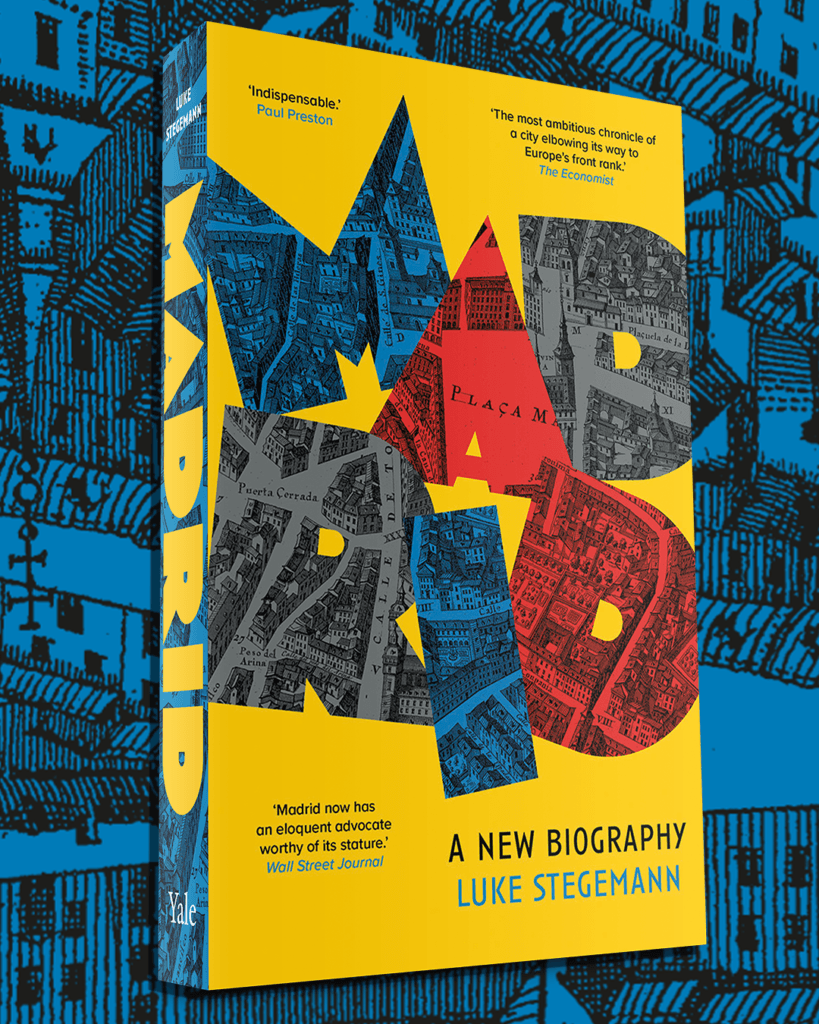
There’s a particular kind of authority that only comes from decades of showing up somewhere — not as a tourist, not even as an expert parachuted in for research, but as someone who has genuinely lived inside a place’s contradictions. Luke Stegemann has that authority with Madrid. He first arrived from Australia in the mid-1980s, when going to Spain at all was an unusual choice for a young Australian, and he’s been circling back to the city ever since. His new book, Madrid: A New Biography, is the result of nearly two years of concentrated writing built on top of roughly fifteen years actually living there, spread across four decades.
I sat down with Luke for this episode of the podcast (on Spotify, Apple and YouTube) to talk about how the book came together, what surprised him after all that time, and the three moments he thinks did the most to shape the city. The Wall Street Journal called the book “masterly,” praising the way Stegemann brings people to life so that Madrid teems not only with kings and their consorts, but with writers, artists, rebels and villains. If you’re on the fence about buying it, just take a listen to this show, which not only showcases Luke’s encyclopaedic knowledge about the city’s history, but also includes his insights into what might lie in store for Spain’s capital.
From the author
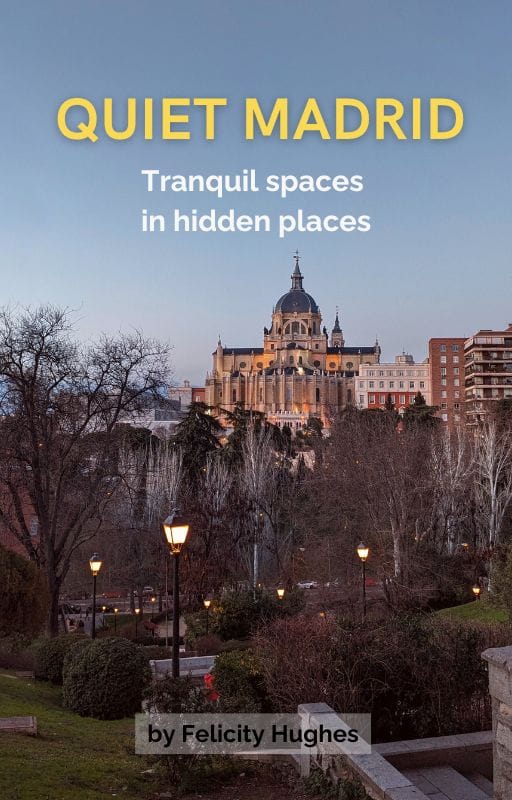
Want to escape the tourist crowds?
My ebook Quiet Madrid reveals the tranquil spaces and hidden places that most visitors never find — five neighbourhood walks, insider timing tips, and a Lonely Planet writer’s years of local knowledge.
Get your copy — €15 → Interactive ebookA book that found its Spanish publisher before its English one
One of the stranger threads in our conversation was how backwards the publishing timeline ran. Early in 2023, with the book only half written, an article about Luke appeared in El País. Within weeks, an editor at the Spanish publisher Espasa emailed asking whether the Spanish rights were available — before Luke had even signed with an English-language publisher. He offered to send sample chapters. Espasa said not to bother, and instead asked how long he needed to finish. He said a year and a half, maybe two. They gave him five or six months, timed to land at the Madrid Book Fair in June 2024.
Meanwhile Yale University Press, who took on the English edition, was aiming for a September or October release that same year. The result: a Spanish translation reached shelves before the original English text did, which even Luke agrees is an unusual way round for these things to work. The Spanish press response, by his account, was uniformly warm — El País, El Confidencial, ABC, El Mundo, plus a run of radio interviews — and he hasn’t come across a negative review in either language yet.
What actually surprised him
You’d expect someone who has read this deeply into Madrid’s history to arrive with few surprises left. Not so. What struck Luke most was how completely the city’s architecture and identity have turned over across the centuries. Islamic Madrid, medieval Madrid, Renaissance, Baroque, neoclassical, nineteenth-century Madrid — each version has largely erased the one before it. Drop into almost any century of the last thousand years and you’d be looking at a genuinely different city, not a variation on the same one.
That erasure runs through the whole conversation, actually. At one point we got onto why Toledo still looks the way it does — mosques, synagogues, churches, all intact — while Madrid keeps knocking itself down and rebuilding. Luke’s answer: Toledo owes its preserved, almost frozen-in-time status largely to Philip II’s decision not to make it the capital. Madrid, chosen instead, has spent the centuries since being continually demolished and remade.
Three moments that made Madrid
I put Luke on the spot and asked him to pick three events that most defined the city he’s spent so long studying. He landed on:
1083–85, the Reconquest. Alfonso VI takes Toledo in 1085 and Madrid into the bargain but historians still argue over the exact date and sequence. This is also roughly when the apparition of the Virgin of Almudena is said to have appeared in the city walls. A few decades later Madrid survived a serious Islamic siege that gave the Campo del Moro gardens their name, cementing the city’s role as a fortified outpost guarding the road to Toledo, rather than anything resembling a capital.
1561, Philip II’s decision to settle the court in Madrid. Charles V had pushed for Lisbon, arguing that an empire looking toward the Atlantic needed an Atlantic capital. Toledo was the other obvious contender, but as the seat of the Spanish church, it came with powerful bishops Philip had no interest in negotiating around. He’d also spent part of his childhood in Madrid and liked the hunting nearby. Whatever the real mix of reasons, the decision ended Madrid’s status as minor town that played host to the itinerant court, setting it up for a major role in the centuries to come.
The late 1920s and early 1930s. Luke compares this window to Belle Époque Paris or Weimar Berlin: an extraordinary, concentrated burst of artists, writers and musicians converging on the city, many of them meeting at the Residencia de Estudiantes, where Dalí, Buñuel and Lorca crossed paths, and where visitors ranged from Pablo Neruda to Stravinsky. It’s a moment defined as much by who showed up as by what they made — and one that the Civil War cut off abruptly.
On Galdós, Javier Marías, and writing history that people actually want to read
Luke read six of Benito Pérez Galdós’s roughly seventy-five novels while researching the book and came away convinced he ranks among the great nineteenth-century novelists — a contemporary of Dickens, similarly trained as a journalist, similarly gifted at bringing a city’s ordinary residents to life, and, in Luke’s view, unfairly overlooked in English simply for want of good translations. On the twentieth century, he pointed to Javier Marías — inconsistent across his body of work, in Luke’s estimation, but capable of real precision in novels like Berta Isla and Los Enamoramientos, which he credits with capturing a particular slice of mid-century, middle-class Chamberí life.
That balance between rigour and readability came up more than once. Luke’s approach, following the English Hispanist Henry Kamen, is that a historian owes readers the facts, but has some license to blend them with literary imagination — reconstructing, for instance, a scene of Ferdinand of Aragon riding across Spain in disguise to marry Isabel of Castile, built entirely on the sparse, undisputed facts of the journey itself.
The Civil War, and its Aftermath
We spent a good stretch of the conversation on a question I’ve been chewing on for a piece of my own: why doesn’t Madrid have a proper Civil War museum? Luke’s view is that the subject remains too raw to handle without controversy. He also pushed back gently on the instinct to read the Franco period as one unbroken 40-year block. He splits it into two very different halves: the grim, isolated years up to the mid-1950s, and the more open period from the 1960s on; once technocrats took over economic policy, cinema and music began to flourish, and banned books started filtering in regardless — the slow build-up, in his telling, to the Movida.
Where Madrid is heading
Luke pointed to a demographer’s book, Madrid DF, that argues Madrid is the only city on the Iberian Peninsula positioned to eventually reach ten million people — something no Spanish or Portuguese rival could plausibly match. Getting there, in his view, means confronting the same challenges Madrid dealt with for much of the twentieth century clearing the shanty towns that ringed the city until the early 2000s: housing, sanitation, and making sure Madrid’s long-standing homelessness problem doesn’t simply scale up with the population. He also expects the city’s Latin American-influenced, increasingly international character to keep displacing the old idea of a distinctly castizo Madrid — a shift he sees as continuous with a city that has never really stood still.
The Prado, Ribera, and one favourite word
Asked for his favourite spot in the city, Luke didn’t hesitate long: the Prado. In his early years in Madrid, a residence card got him in free on Sundays, when the museum was often close to empty — a hard image to picture today. That’s where he fell for José de Ribera, the Valencian painter who spent his career in Naples and carried Caravaggio’s style into Spain, and who Luke rates alongside Velázquez, Goya and El Greco.
And his favourite Spanish word, for what it’s worth, is paulatinamente — gradually, slowly — which he’s loved since his very first year in the country, mostly for how it sounds.
Listen to the full episode
We covered a lot more than fits here — Madrid’s missing Roman history, the fight over Toledo’s diocese and the reasons the Almudena Cathedral took so long to build, and why some ghost suburbs built during the property bubble sat empty for years. The full conversation is up now on Spotify, Apple and YouTube.
If you’re enjoying The Making of Madrid, the best ways to support it are to leave a review, pick up a copy of my own book Quiet Madrid, or grab one of my audio tours on VoiceMap. There’s no sponsorship and no affiliate links behind any of this — just an independent show that runs on listener support.