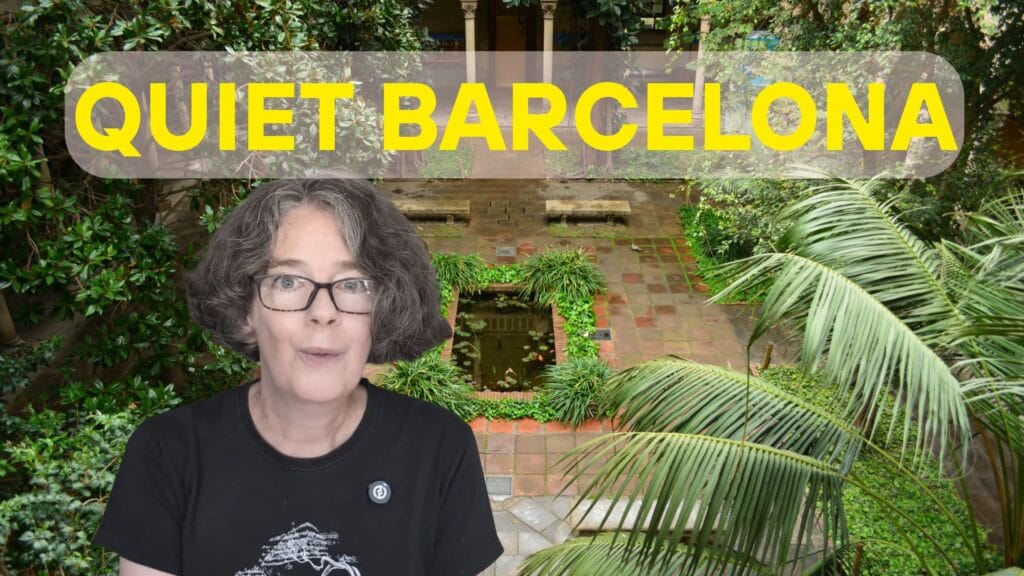
For this one, I’m defecting to Barcelona, much though I love Madrid. But I’m doing the city a bit differently, covering sites away from the big hitters that are on everyone’s itinerary on a first visit: La Rambla, the beach, the Sagrada Familia, and other Gaudi masterpieces like Park Güell. This is a quiet weekend in Barcelona and not only that but an itinerary that serves as a little introduction to the history of the city.
If You’d Prefer to Listen
Why Barcelona?
Barcelona is a spectacular city that really rivals and sometimes outdoes Madrid, especially in terms of fabulous architecture. Here there are more than 2,000 what are called Modernist buildings (Catalonia’s answer to Art Nouveau). Madrid has far fewer and only one really spectacular one: the Palacio de Longaria in the Barrio de Salesas. The whole weekend I was gawping at this amazing architecture, set against the backdrop of the sea and beautiful surrounding mountains. It’s one of the densely populated spots in Europe but, incredibly, I actually found myself in some really quiet spaces with a few places to myself, so it’s a good one if you want to get away from the crowds and a nice companion to anyone who has enjoyed my book Quiet Madrid.
From the author
Want to escape the tourist crowds?
My ebook Quiet Madrid reveals the tranquil spaces and hidden places that most visitors never find — five neighbourhood walks, insider timing tips, and a Lonely Planet writer’s years of local knowledge.
Get your copy — €15 → Interactive ebookDay 1: Barrio Gótico
As this itinerary doubles as a historical tour of the city, I of course begin in the oldest part of Barcelona. Unlike Madrid, which was founded by Muhammad I of Cordoba as an outpost of the kingdom of Al Andalus, Barcelona’s history dates much further back to the Romans and the name comes from the Roman original: Barcino. Interestingly, it wasn’t part of Al Andalus for long, though I expect the 85-year, bloody occupation in the 8th century felt pretty long to the locals, who fought their invaders off. Anyway, back to the Romans; you can still see two sections of the Roman wall which used to roughly enclose the Barrio Gótico and the most impressive section is right by the History Museum, which is well worth checking out.
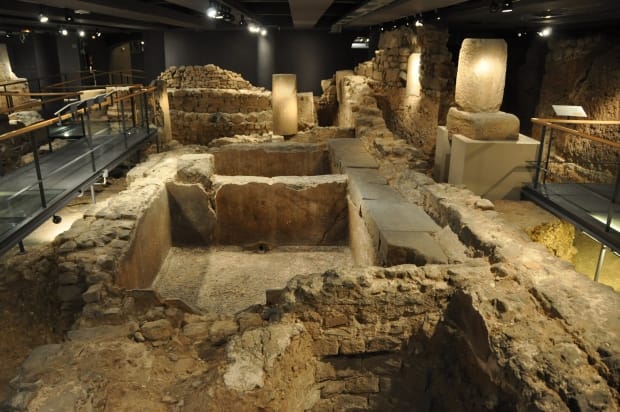
But if you’re short on time and want to see something a bit different, go to Casa Morell aka Domus de Sant Honorat in El Call, which is the old Jewish quarter. This is the first place I managed to go that had absolutely nobody in it on a weekend in peak season, no less – be aware it’s only open weekend mornings. It’s a 19th-century house built on a medieval warehouse, built on a Roman noble’s residence. And you go below ground to the foundations and see evidence of this: medieval silos that contained silk, coral and grains and below that, beautiful Roman mosaics with stunning geometrical designs. It’s just a couple of euros to enter and slightly cheaper if you have a library card in Spain!
It’s located in what’s called El Call, which was the Jewish quarter. Barcelona had a huge Jewish population up until the 14th century and this place was run by a Jewish woman named Masot Avengeña. The population was decimated in August 1391, when 300 Jews were killed. This massacre also took place in Madrid and I have a post on the Jewish history of Madrid. Many of those left converted, and that included Masot, who closed up shop around this time.
So I discovered this place just wandering, and that’s part of the joy of a second visit where you’re not pressed to see the big sights with tons of crowds. The Barrio Gótico is just marvellous for wandering around the unplanned medieval streets. However, I do admit however that I popped in to see the cathedral – not referring to the Sagrada Familia, but the Gothic cathedral to see the 13 white geese that live in the pool in the 14th century cloister. There have been geese here since the 16th century; these represent, according to tradition, the age of Saint Eulalia when she was martyred. The story goes that she was subjected to thirteen horrifying agonies, some of a sexual nature, before finally being crucified, naked, on a saltire, or St Andrew’s cross. She’s one of the city’s two patron saints. Incidentally, Eulàlia, Lali, Laia, is one of the most popular names for girls in Barcelona.
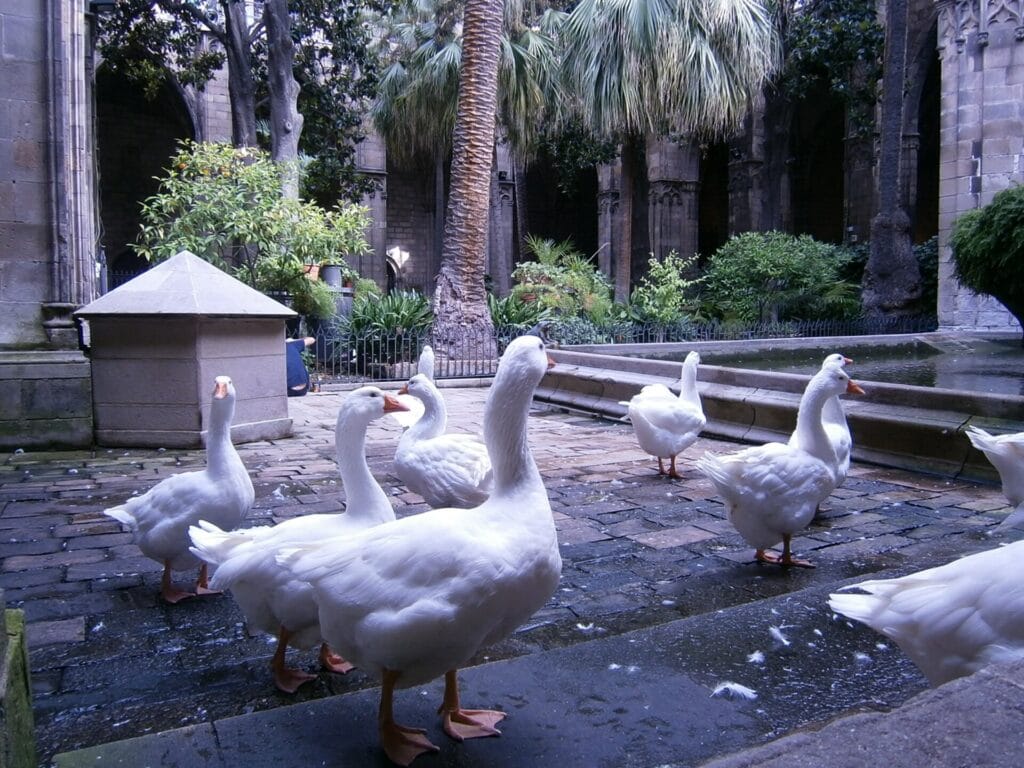
I’m glad I briefly braved the crowds because the medieval masonry on the columns is spectacular. Look out for Sant Jordi or Saint George, he’s a saint closely linked to Catalan identity, sticking his sword into the dragon’s mouth. It’s a motif that crops up again and again in Barcelona in modernist buildings too. on 23 April is his saint’s day beautiful that Catalans give books and roses to their crushes. However, to avoid seeing any crowds at all, you can skip the geese and see the 12th-century Església de Santa Anna instead. This tucked-away church is famous for its concerts, so check out the programme when you’re there.
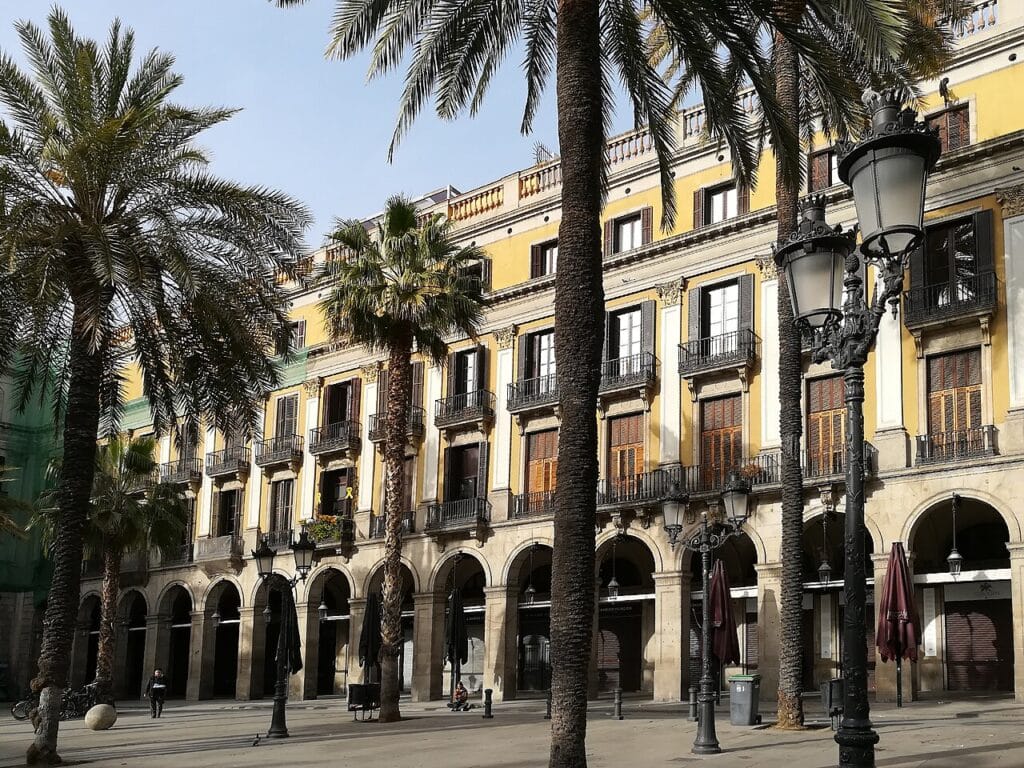
You’ll of course want to take a break on your travels and happily, Barrio Gótico is full of quiet squares waiting to be discovered. It’s a bit of a choose-your-own-adventure situation her but I chose to have a coffee in the Plaça Reial, which is a bit busier than the smaller squares but unmissable for me, as it’s a location of the action in Carlos Ruiz Zafón’s Shadow of the Wind. Filled with palm trees and mid-19th century architecture, the street lamps here are earlier more conservative works by the then-unknown architect Gaudi. For a coffe here, I recommend Ocaña, which has beautiful interiors – apparently on weekends, the waitresses are sassy drag queens.
Another famous Shadow of the Wind location is Els 4 Gats. A bohemian hangout back in the day, both Gaudi and Picasso are said to have frequented this institution. I didn’t go inside as it was swarmed with Korean tourists. It’s still worth it to check out the stunning Modernist and Neo-Gothic exteriors by architect Josep Puig i Cadafalch, but if you’re hankering after a drink in an artsy setting, go to Bar Pastis.
My last stop of the day was Base Elements, a gallery run by Robert Burt, who turned out to be a lovely guy from Los Angeles who curates a wonderful collection from Barcelona’s street artists. Robert is an artist himself and knows loads about the history of the city, so if you pop in don’t be shy to have a chat. He’s a mine of information. Along with lots of interesting stories, over the years he has collected old religious icons, stucco work and tiles from the streets and repurposed them into artworks with a loving and humorous touch.
Day 2: Montjuïc and Esquerra de l’Eixample
Morning in Montjuïc
Montjuïc is a 177.72 m high hill overlooking the city that, over the years, has made a great defensive point. The name means the mount of the Jews and is a reference to the medieval Jewish cemetery there. If you want to get to the castle at the top, the best way is via a cable car. This castle isn’t exactly beloved by Catalans, it’s a pretty big symbol of repression, first put here in 1640 by the Spanish who were trying to suppress a revolt. The reasons were complex, but put simply, they were caught in the middle of the 30-years-war between the Spanish and the French and not very happy about being ruled by the monarchy all the way over in Madrid. However, the rebellion went badly; while they briefly got a Catalan republic, this was crushed and in 1659 a Spanish treaty with the French meant Catalonia was split up, with northern parts going to France.
Another big conflict got underway during the War of Succession when Habsburg King Carlos II died in 1700 without an heir. Habsburg Austrian and Bourbon French pretenders started fighting for the throne. Obviously, the Catalans were not too keen on the French by this point; they backed the Austrian side and paid the price. The Bourbons invaded and beefed up the castle. Later on, the castle was synonymous with torture and repression. In the late 19th century, many anarchists were held there and tortured before being put on trial. In any case, I didn’t fancy Montjuïc Castle because of this dark history and the huge queues for the cable car, which you really need to book in advance. But I think it’s important to understand this aspect of Barcelona’s history.
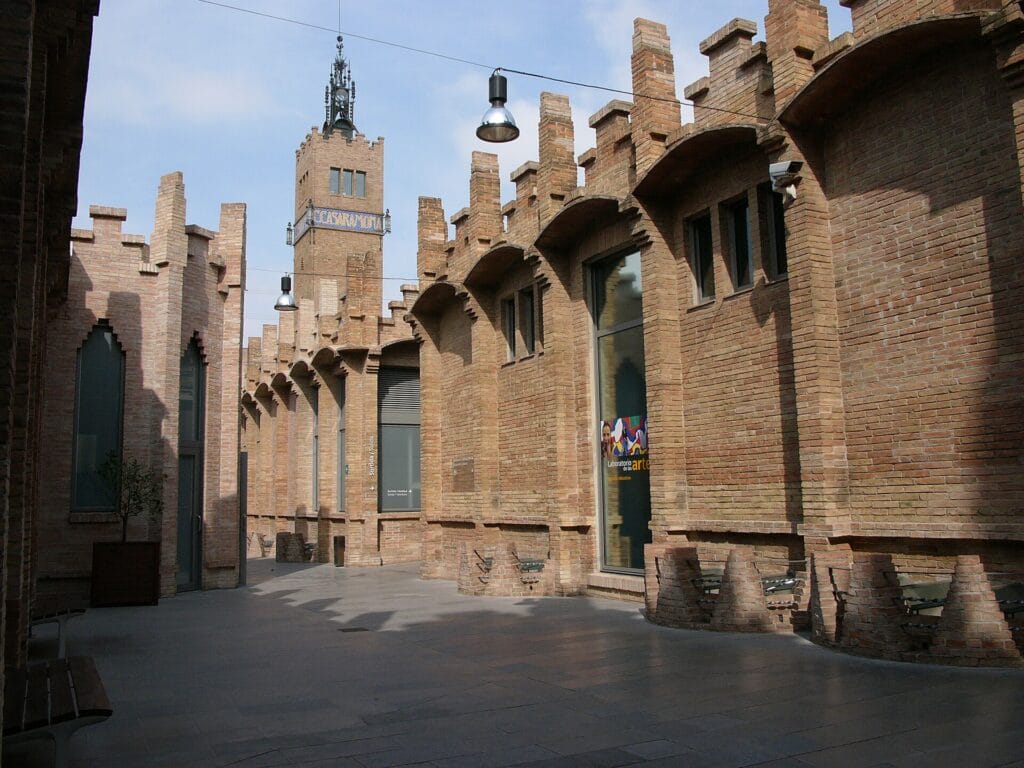
Despite all this repression, Catalonia got super rich in the late 19th century and early 20th century. This was when Madrid was in decline, losing Cuba, which was the last of Spain’s colonies. Barcelona, meanwhile, exported aguardiente spirits to this new market and began producing so much fabric that it rivalled England in the cloth trade. With all this wealth a lot of lovely houses and factories went up. Out in the foothills of Montjuïc is the old Casaramona fabric factory. Now the CaixaForum art gallery, it’s a real modernist gem, made by the guy who did Els 4 Gats, Josep Puig i Cadafalch. Though the gallery is reasonably popular, the cafe is gorgeous and quite quiet, plus even better, we found the upstairs terrace totally deserted.
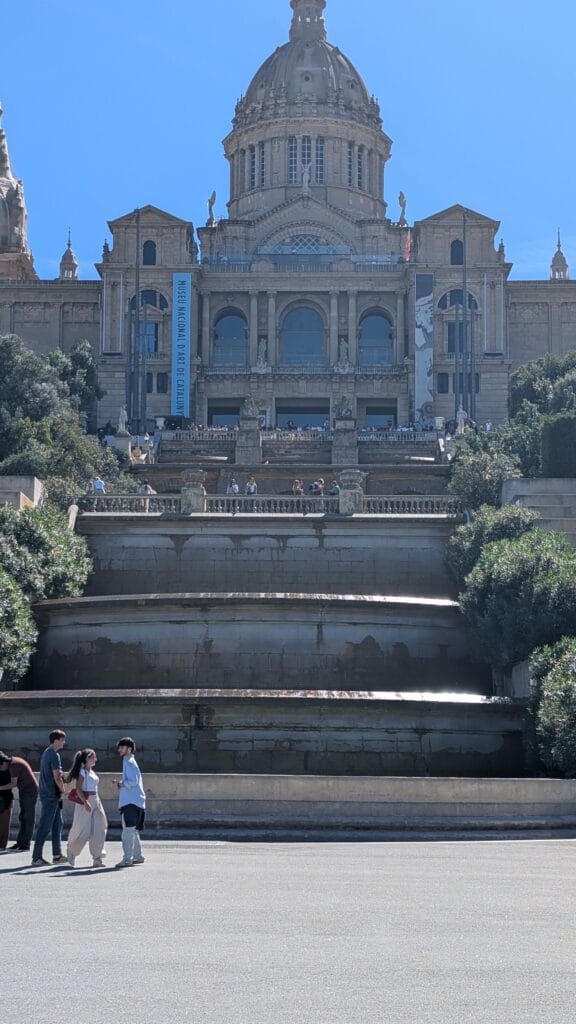
Here you get views of the bullring and the National Art Museum of Catalonia, which sits slightly further uphill. That was my next destination. It was originally built as the Montjuic National Palace for the 1929 World Fair and it’s really impressive. You can see Barcelona really sticking its chest out here and saying to Madrid, ‘Think you’re so great do you? Well, how about this!’ The collection inside is incredible and if you go after 3pm on a Saturday, it’s free. But this is quiet Barcelona, so buy a ticket and enjoy the peace.
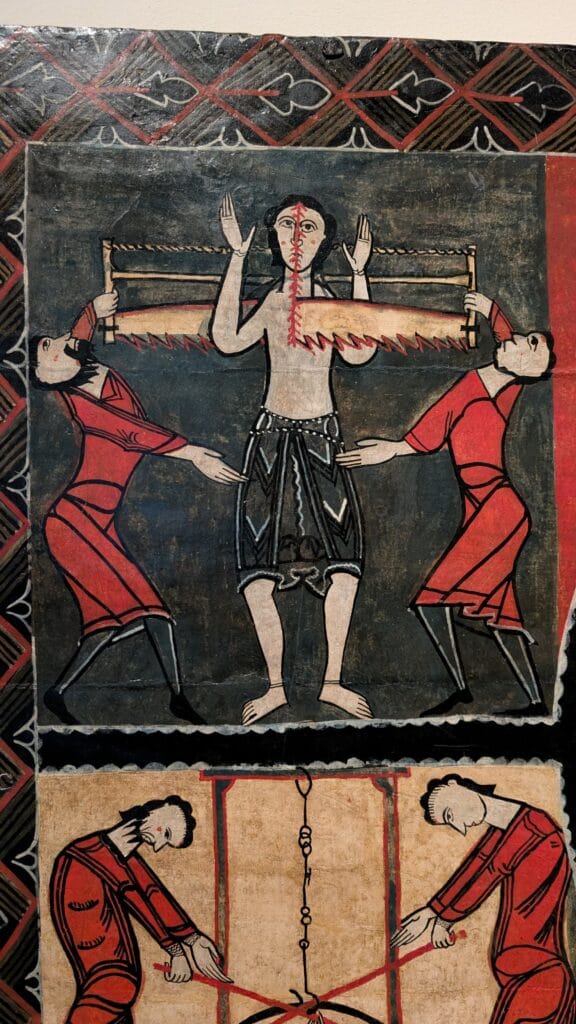
I went specifically for the Romanesque medieval art. It was the most stunning collection of medieval frescoes I’ve ever seen. Utterly hilarious at times because, well, much like early AI, artists sometimes struggled with the hands! And while it’s cartoonish in a way, there’s this shocking brutality, like a guy literally getting sawed in half, a man having nails driven into his head and the capital of a column that shows a man being eaten by a lion, being attacked by an eagle – overkill! I also loved the late 19th-century art where you have all this blossoming of Catalan creativity. Gorgeous painters like Ramon Casas and Mariano Fortuny. Just beautiful, and you can see here how all this wealth pouring into Catalonia sparks an artistic renaissance, which is best known because of the architecture. So to get a bird’s eye view of where you’re going to go next, nip up to the roof – it’s a bit of a maze but well worth it. Here you’ll see Barcelona spread out before you and the Sagrada Familia, of course, in the distance.
If you space on doing that or skip this bit go to the rooftop in the bullring. This building is now a shopping centre, because the Catalans are a lot less barbaric than the rest of the Spanish and have outlawed bullfighting. Pro tip here: don’t take the glass lift outside, which costs €1.50, go inside and take the free lift. Again, you’ll get these stunning views of the city.
Then, once you’re down, you can recharge your batteries in the Park of Juan Miro before the next part of the tour. Here you’ll find a huge sculpture by the Catalan artist that I caught glinting in the sunlight at sunset, because, full confession here, this itinerary is retrofitted from four days I spent wandering the city so you don’t have to! Anyway, the sculpture is huge and it was done in 1982, a year before the artist died – I imagine he had helpers though. The sculpture has this lovely broken ceramic mosaic that can be seen all over the city. Incredible, really, as it’s enormous.
Afternoon in Esquerra de l’Eixample
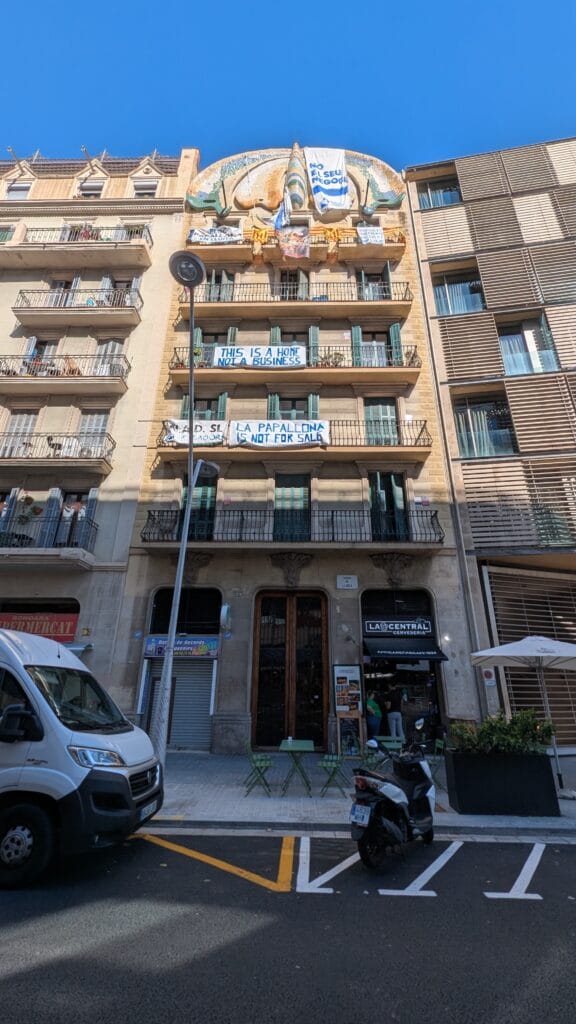
Round the corner from the bullring, you can see another building with this lovely effect, this time in the shape of a butterfly. It’s called la Casa de la Papallona (the house of the butterfly). This is the beginning of the whole Esquerra de l’Eixample area, which was designed by Ildefons Cerdà in the late 19th century on a grid pattern. A new addition is Mayor Ada Colau’s Superblocks (Superilles) or Green Axes, where four of the blocks are put together, pedestrianized and filled with beds of plants, making the city less traffic-choked and much less brutally hot in summer.
One of my nicest moments there was sitting on a bench and chatting to an elderly lady from the city who told me how nice they were to hang out in. I also visited a small gallery and chatted to the artist, who again was super friendly and then wandered into the old doll factory Antigua Fabrica de Muñecas de Lehmann, which now is suitably gentrified.
To round off the day I went to the main campus of Barcelona University. The building is handsome but is neo-Romanesque, so not a good example of the bold, exciting modernist Catalan architecture I’d seen in the Esquerra de l’Eixample area. This space is more serious and staid, but it’s gorgeous and open to the public. The cloisters and the garden out back are delightful.