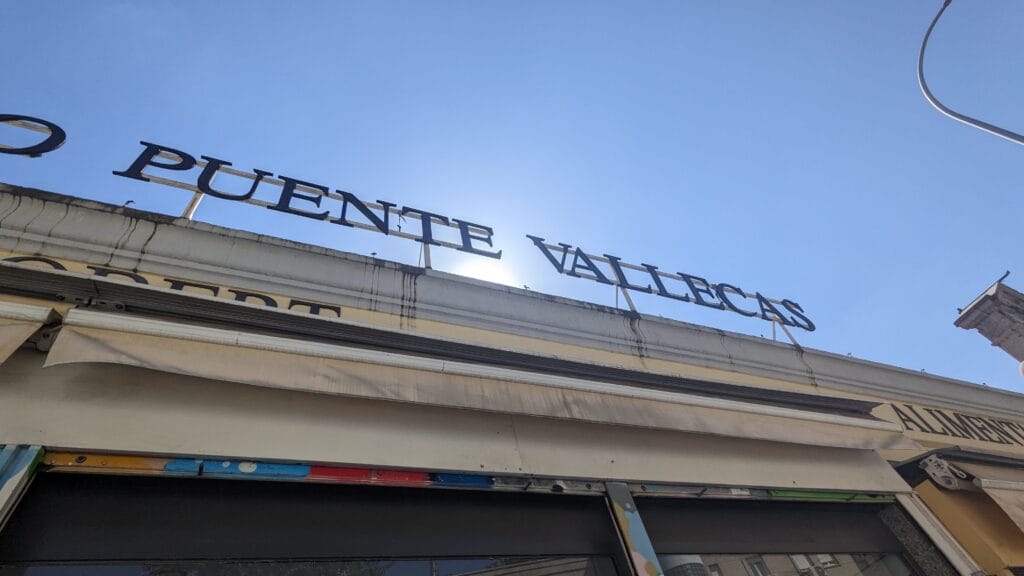
A neighbourhood guide and self-guided itinerary for one of Madrid’s most rebellious districts.
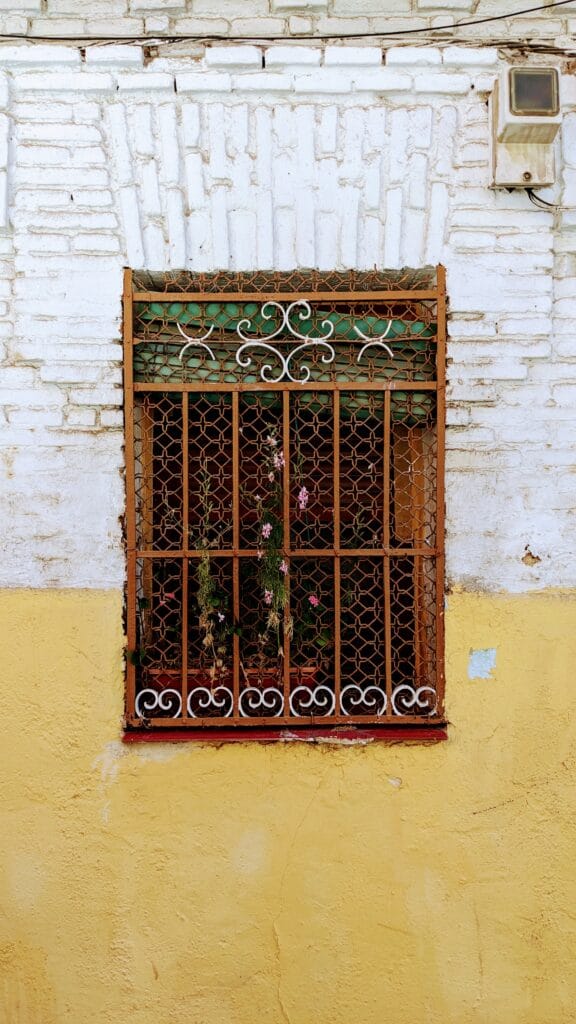
I’ve been meaning to do a proper barrio guide to Puente de Vallecas for years, but as I live in Usera, I rarely get out there. Though it’s technically adjacent, I always end up having to go into town and back out again to get there by public transport; if I wasn’t so weedy about going on main roads on my bike, it’d be another story! In any case, the day the pope came to town and shut down central Madrid gave me an excuse to finally commit to a full day out. I wish I’d done so sooner. With flamenco, food, fascinating history, a beautiful boulevard, and one of the best sunsets in the city, it was a brilliant day out. If that sounds up your street, read on (or listen to the podcast).
Prefer to listen?
What’s in a Name?
Vallecas is composed of two distinct places: Puente de Vallecas and Villa de Vallecas. The latter is a separate town further out that has its own much longer history going back to the 17th century — they used to extract flint and lime out there, and it was rebellious enough to threaten to cut off Madrid’s bread supply during a power struggle involving Juan of Austria and the Queen Regent. While this story has piqued my interest for a future piece, this is not the focus of this post.
This guide is entirely about Puente de Vallecas, which is closer to the city centre and is the neighbourhood most people mean when they just say “Vallecas.”
A Brief History
The name gives you the first clue. Puente means bridge, and this area used to be cut off from Madrid proper by the Abroñigal stream. In the late 19th century, a bridge was built, and the city started pushing its (most likely contaminating) manufacturing out this way. Now the stream is buried under the M-30 ring road that loops around Madrid. Completely the opposite of Usera, where the M-30 runs underground with the beautiful Manzanares river park on top. In short, in Vallecas, the motorway goes overground, so the neighbourhood feels really cut off if you arrive from Méndez Álvaro and walk under the elevated expressway choked by traffic fumes.
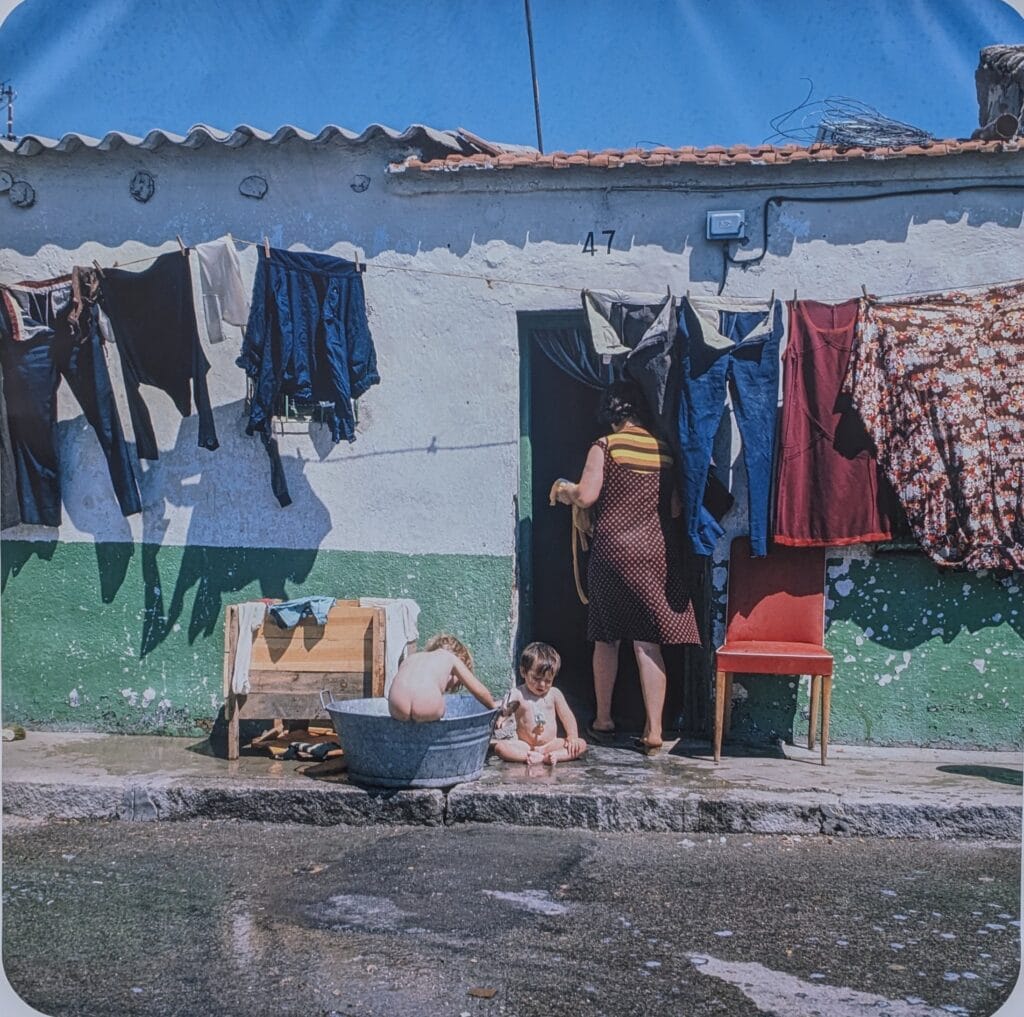
After the industrial era, shantytowns began to appear in the formerly rural zone, with disenfranchised residents fighting for basic amenities. A long-running tension began with Villa de Vallecas, which had its own town hall and kept most of the resources — proper sewage, paved roads — even though the majority of people actually lived in Puente de Vallecas. After years of campaigning, Puente de Vallecas finally got its own city hall in the 1930s.
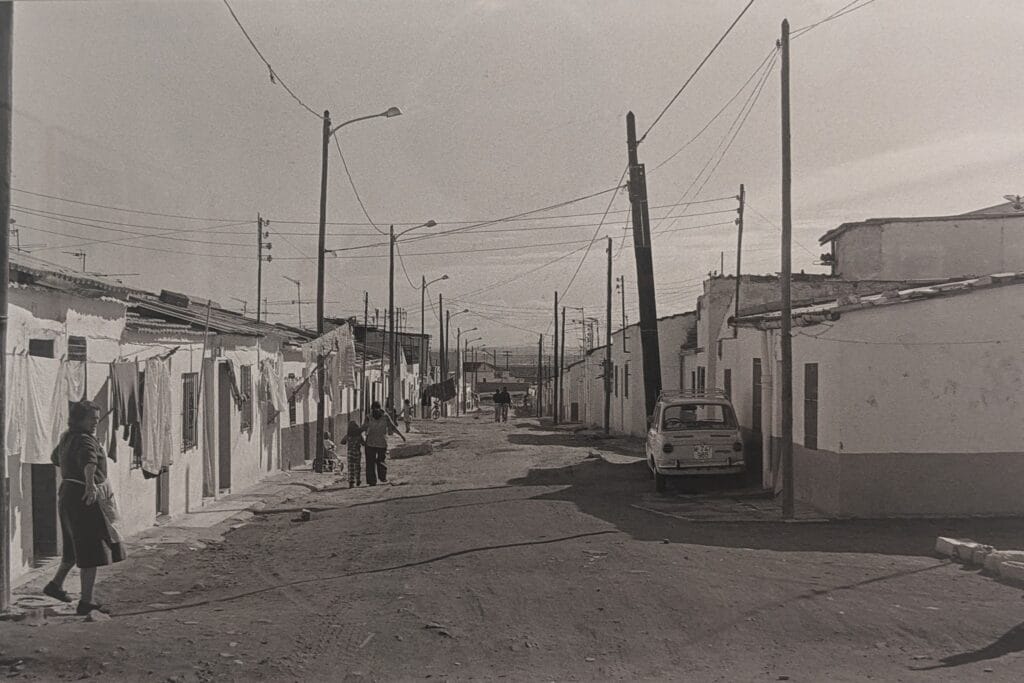
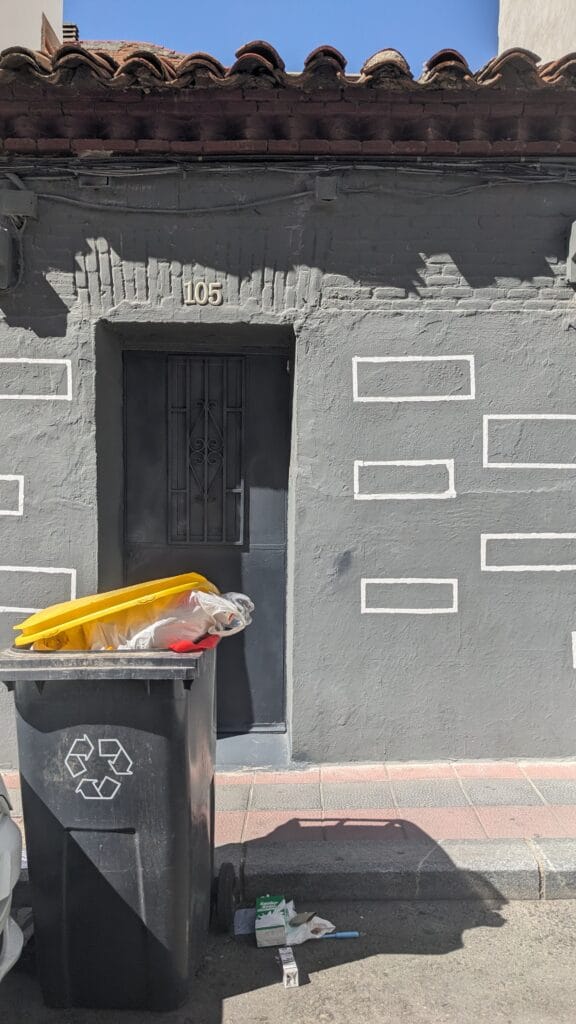
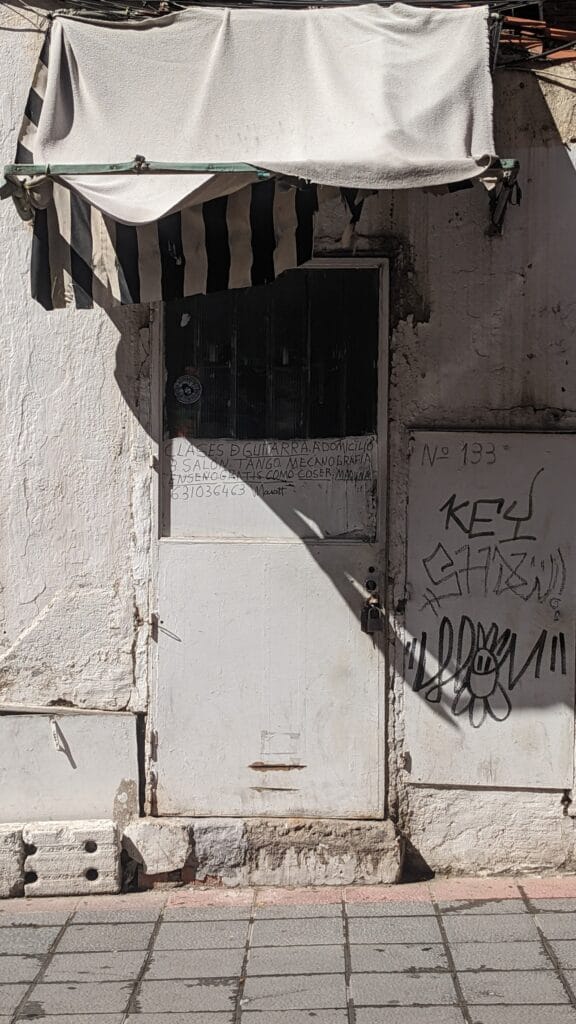
Soon after the outbreak of the Civil War, the Siege of Madrid began here, with Vallecas taking the first hits from German and Italian air forces sent to help Franco’s Nationalists break through into the city. This was, and remains, a deeply left-wing neighbourhood, and resistance was fierce. Much of Vallecas was demolished in the aftermath of the war, when shacks went back up again, and the area remained largely a shantytown well into the 1950s and 60s. Though a lot of the slum housing is gone, a surprising amount remains.
The Itinerary
Stop 1: Robert Capa’s House — Calle Peroncel, 10
I started my day in the Entrevías and San Diego districts. This part can feel quite rough. There was rubbish left out on the streets, overflowing bins (collection in some of Madrid’s poorer barrios is scandalously bad), and a car with a note in the window reading “please don’t break — there’s nothing of value here.”
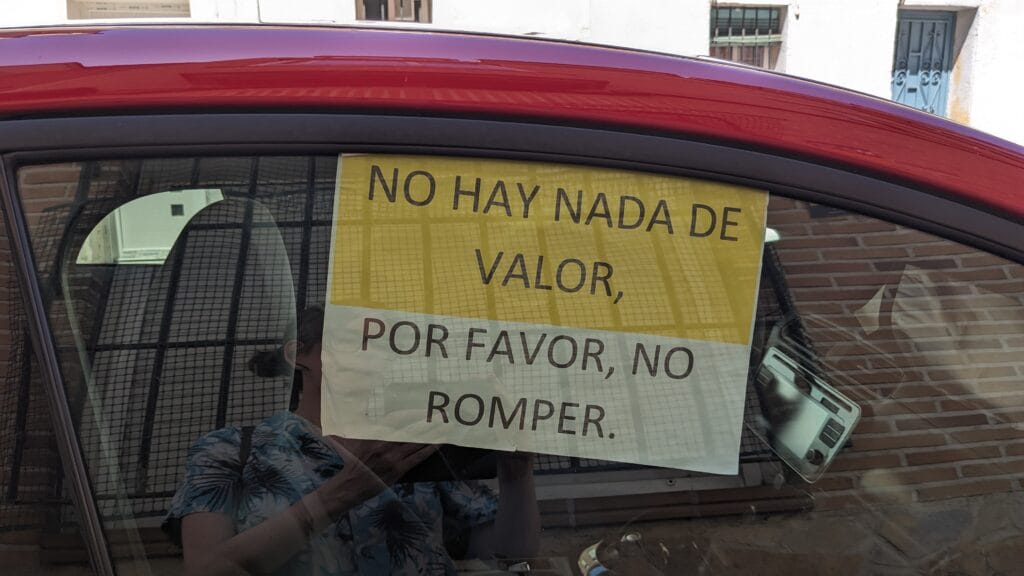
I’m starting here, because this is where the recent history of Vallecas begins.
Robert Capa was a Hungarian photographer who made his name documenting the Spanish Civil War. In November 1936, when Vallecas became the first part of Madrid to be bombed, he photographed a house on Calle Peroncel with children playing outside — the building riddled with shrapnel. Incredibly, that house is still standing today.
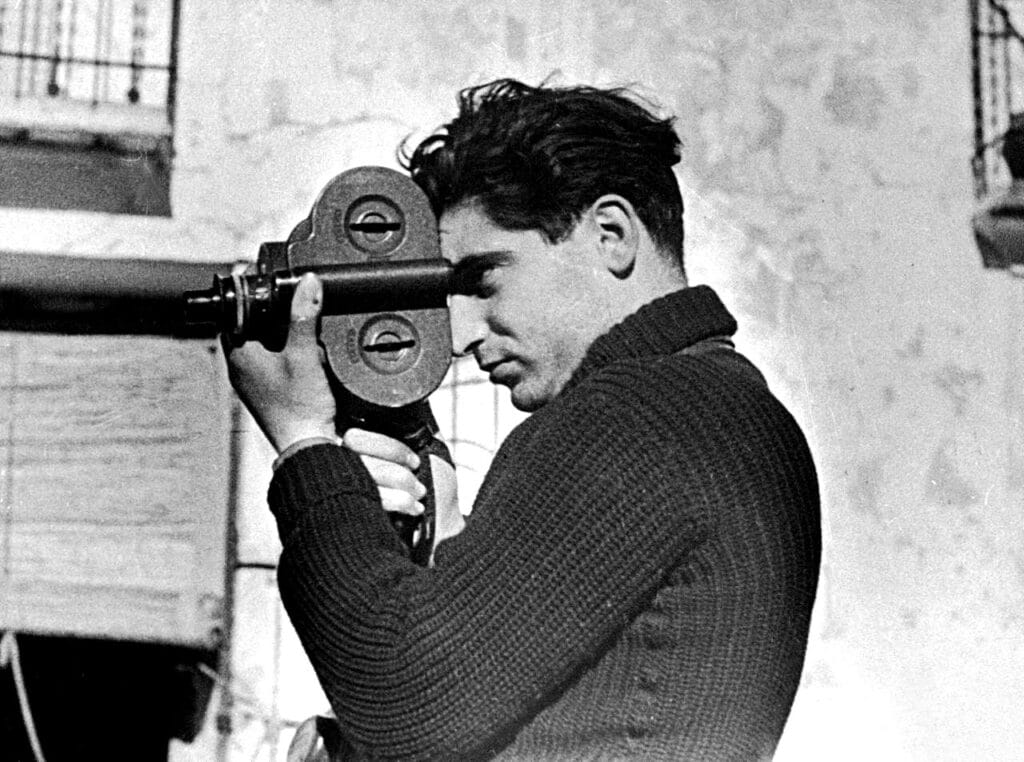
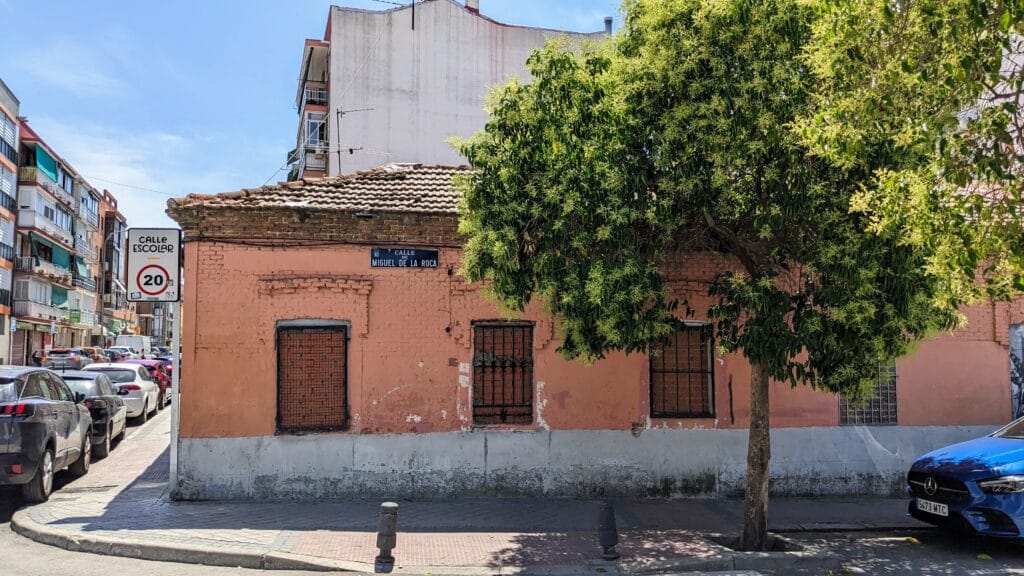
For a long time, it was emblematic of persistent deprivation in the neighbourhood. After a lengthy campaign, the residents were rehoused and the local government paid €800,000 to acquire the property, with plans for a museum dedicated to Capa’s photography, a move his estate enthusiastically supported. Then, recently, the right-wing PP-controlled local council announced a change of plan. It would become the Centro de Experimentación Cultural Robert Capa, essentially a youth centre, with “a few photographs” by Capa included. His estate is furious. The row is very much ongoing, and folds into a bigger debate in Spain about whether Madrid will ever get a proper public museum dealing with the legacy of the Civil War.
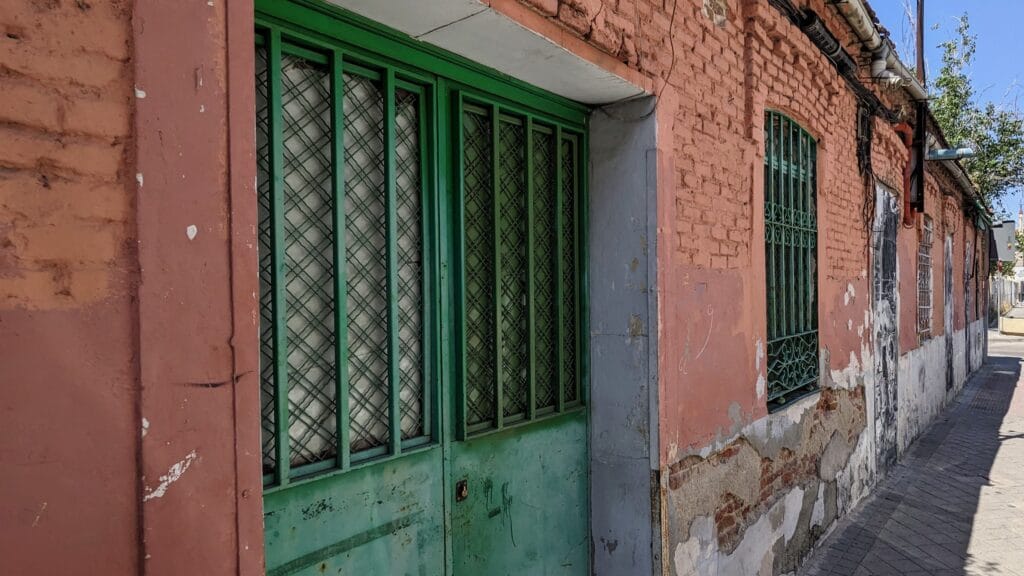
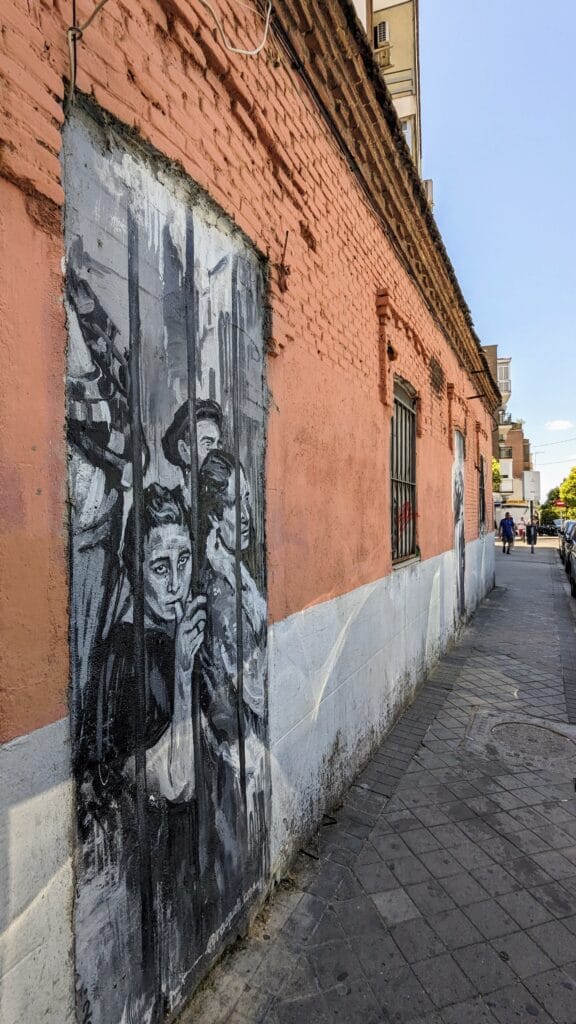
When I visited, the facade had been painted with recreations of Capa’s photographs. The building is currently boarded up, so there isn’t much to see beyond the exterior, but it’s worth pausing here.
Stop 2: The Tiled Facades on Avenida de Monte Igueldo
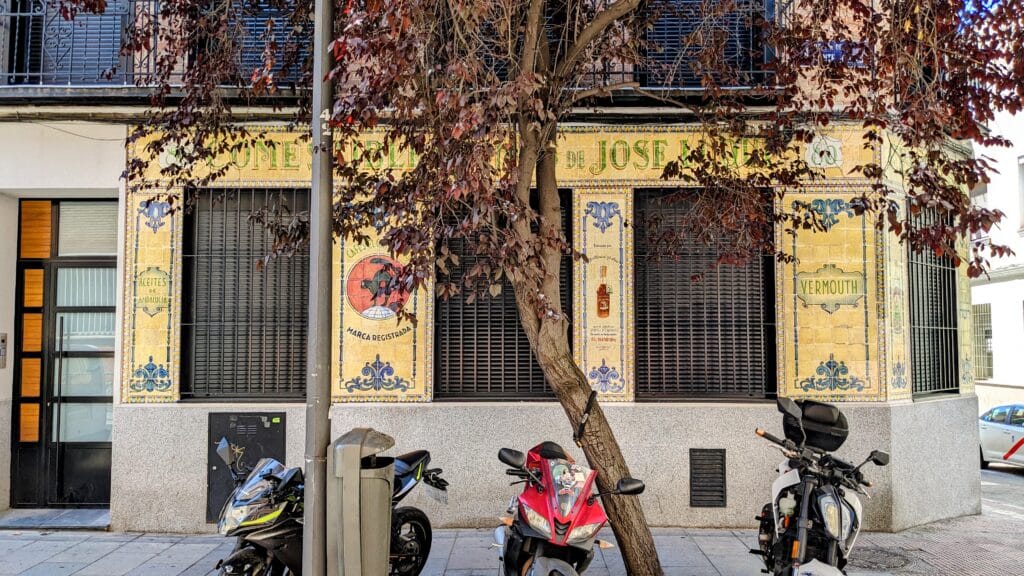
From Capa’s house, it’s about a 15-minute walk down to Avenida de Monte Igueldo, where the neighbourhood starts to feel notably more welcoming. I’d say that if you’re not keen on the rougher end of the itinerary, you can skip the first stop and begin here.
At number 96 on this avenue, you’ll find the beautifully tiled facade of an old bar — now closed, but protected as cultural heritage. I am obsessed with 1920s tile art in Madrid and the recently reopened Los Gabrieles is the undisputed cathedral of the genre if you don’t make this trip.
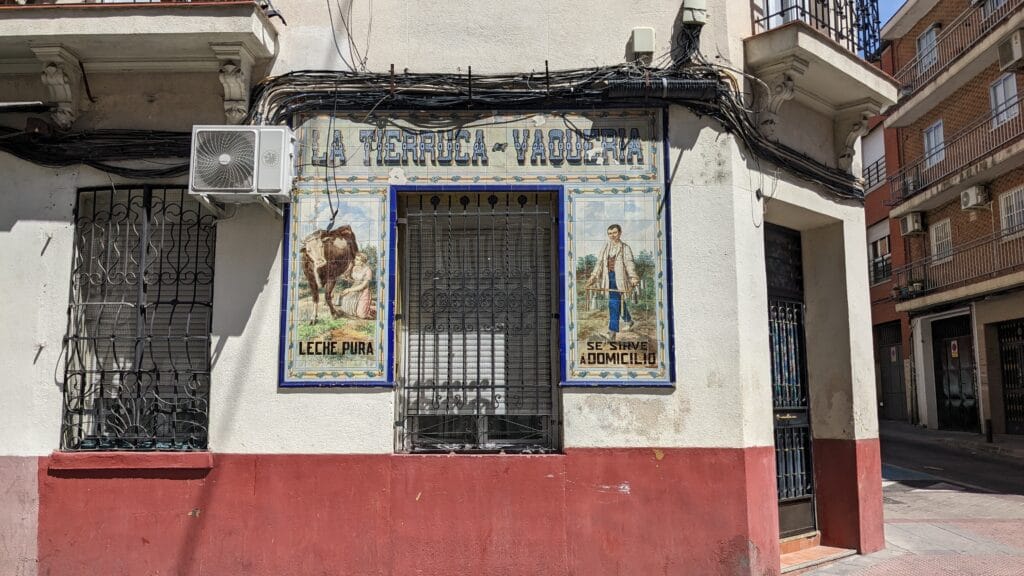
A little further down the same street on your right is more tile art, this time for a lechería — one of Madrid’s old milk bars. From the late 19th century, these were enormously popular. Here you’d go in and drink fresh farm milk to get a daily dose of calcium, a little like the bottle of milk I was forced to drink daily at school (yuk) until Margaret Thatcher ‘the milk snatcher’ put an end to this government scheme.
Stop 3: Snack at Teke Madrid (Venezuelan Street Food)
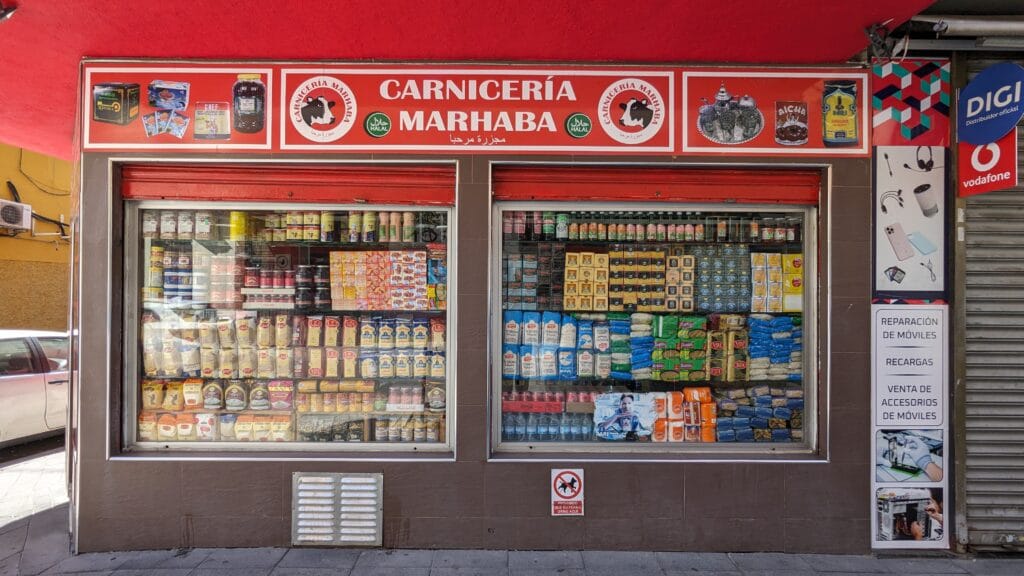
The avenue itself is lined with second-hand clothes and furniture shops, as well as lots of restaurants. These reflect the fact that Vallecas is a genuinely multicultural neighbourhood. It reminded me a lot of Usera in that sense, but with a slightly different mix: both districts have big South American communities but whereas Usera has a big Chinese community, Vallecas has more North Africans, so you’ll find lots of halal butchers and burger joints. La Perla del Norte, where you can get Moroccan dishes, seems to be well loved by locals.
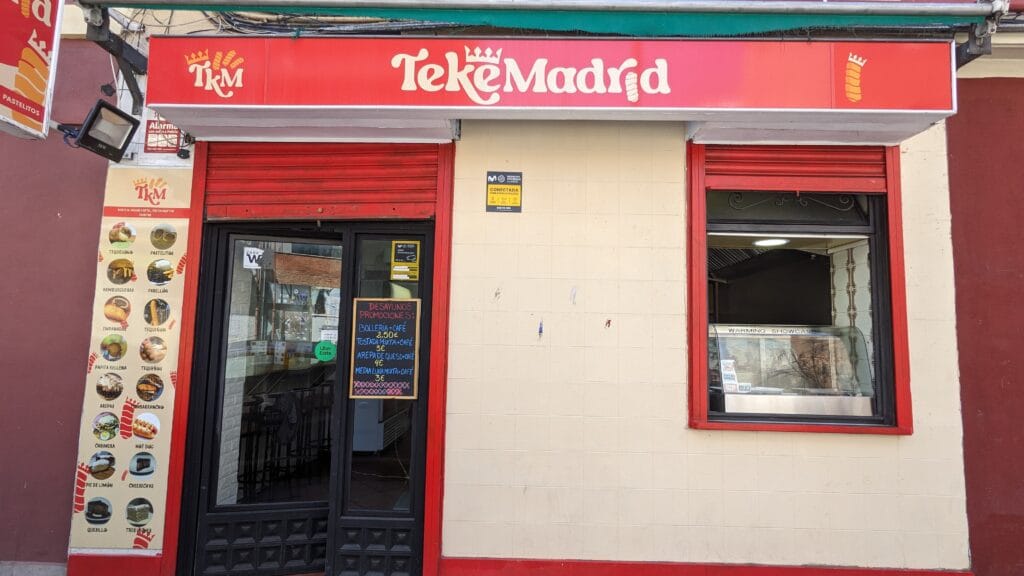
I went to Teke Madrid, a local chain famous for tequeños (fried cheese sticks) and other Venezuelan street food. Being somewhat sensitive to wheat, I went for a papita de yuca, a fried yuca ball filled with gooey cheese, which cost only €2.90 and came with sauces of parsley, coriander, and a touch of mayonnaise. Soooo good! The friendly guy behind the counter turned out to be Venezuelan himself and had been living in Madrid for a couple of years. One in seven Madrileños is now from Latin America, and my sometimes choppy understanding of his accent was a reminder that I have to improve my listening skills for other kinds of Spanish speakers!
Stop 4: Bodegas Frutos
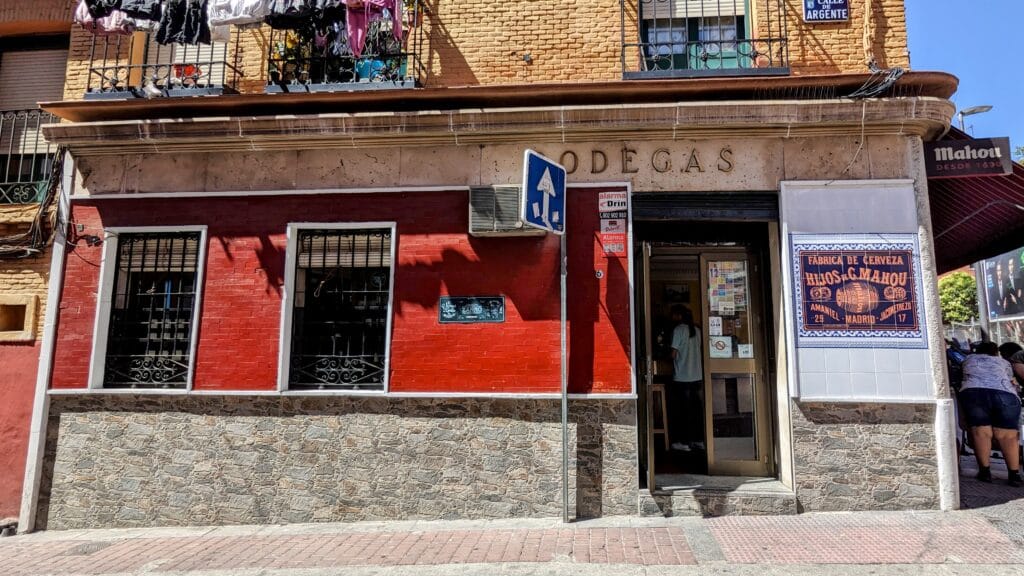
I also walked past Bodegas Frutos on the way and nearly stopped for a coffee, it had a punky, friendly vibe and I’ll try to go next time I’m in the neighbourhood. In the end, I kept going (no condensed milk for the café bombón I was craving, and it was quite noisy), but if you’re after a lively, fun bar, this is worth a look.
Stop 5: Neo-Mudéjar Brickwork Houses
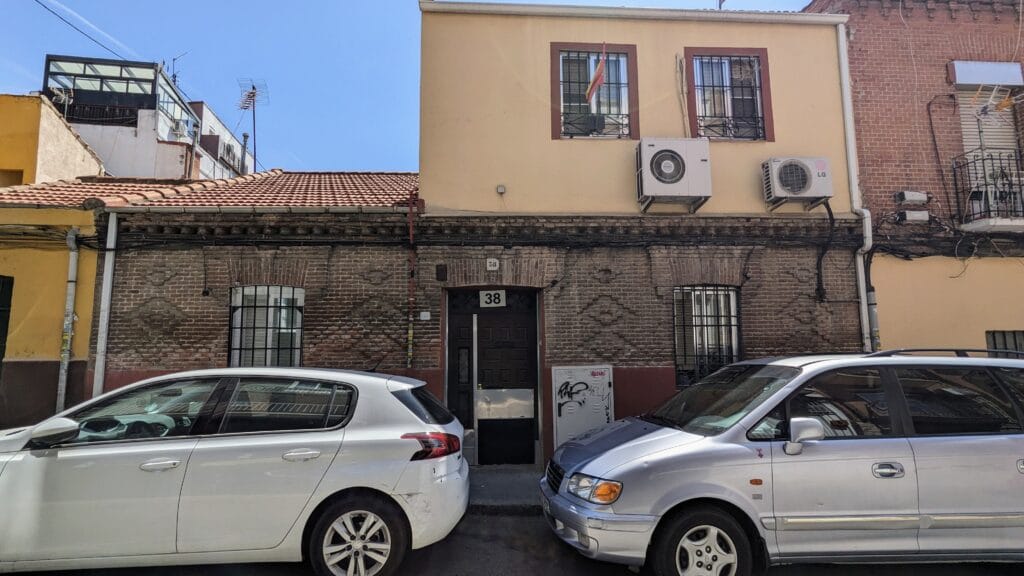
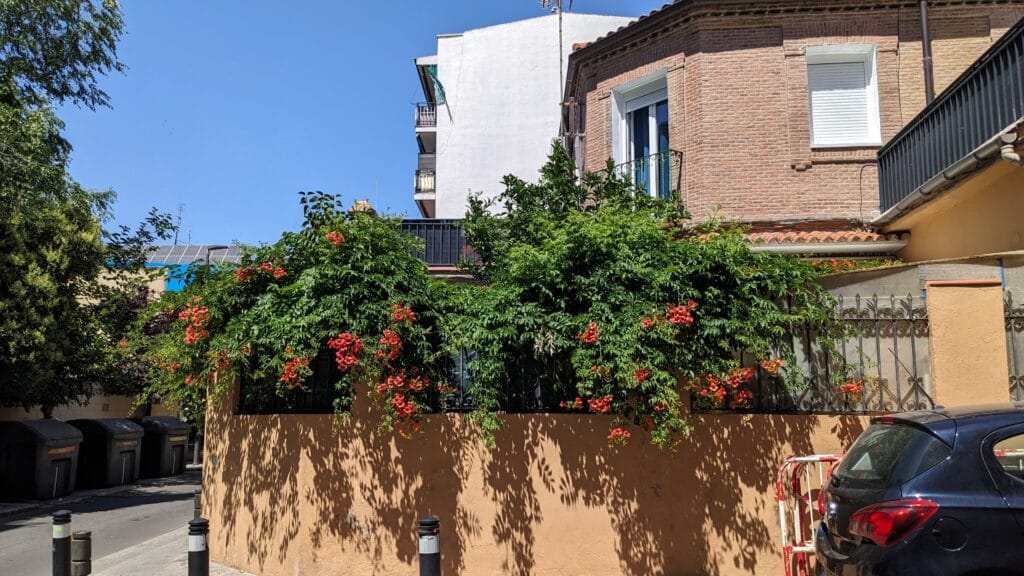
All over Vallecas, I spotted small houses built with the most beautiful decorative brickwork. These are examples of neo-mudéjar architecture — a revival of the mudéjar style that features horseshoe arches, intricate brickwork towers, and decorative brick patterning. This revival of a medieval style of architecture was popular in the late 19th and early 20th century, and artisanal bricklayers who worked on these construction sites became experts in these techniques. You can see their small houses in this style scattered through working-class neighbourhoods like Carabanchel, Usera, Tetuán and Vallecas.
Stop 6: Boulevard de Peña Gorbea and the Abuela Rockera
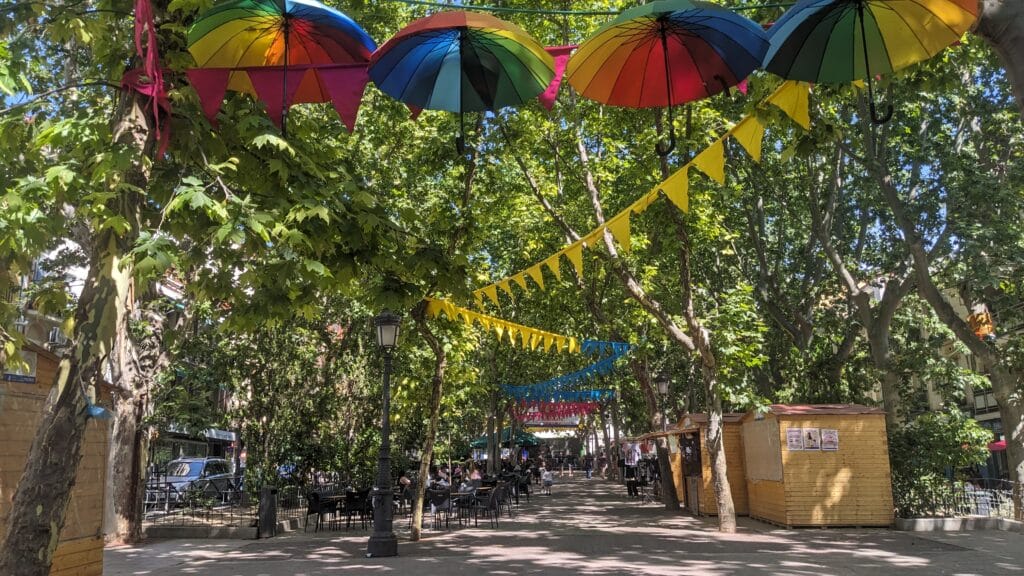
The Boulevard de Peña Gorbea was one of the loveliest surprises of the day. It’s a fully pedestrianised, leafy, beautiful stretch of the neighbourhood near Nueva Numancia metro station — which is also where you’d arrive if you wanted to skip to this point directly. It’s lined with lovely terraza seating where you can have a coffee under dappled shade. The architecture of many surrounding apartment blocks dates from the 1920s: these elegant buildings went up around the time the metro arrived in this area.
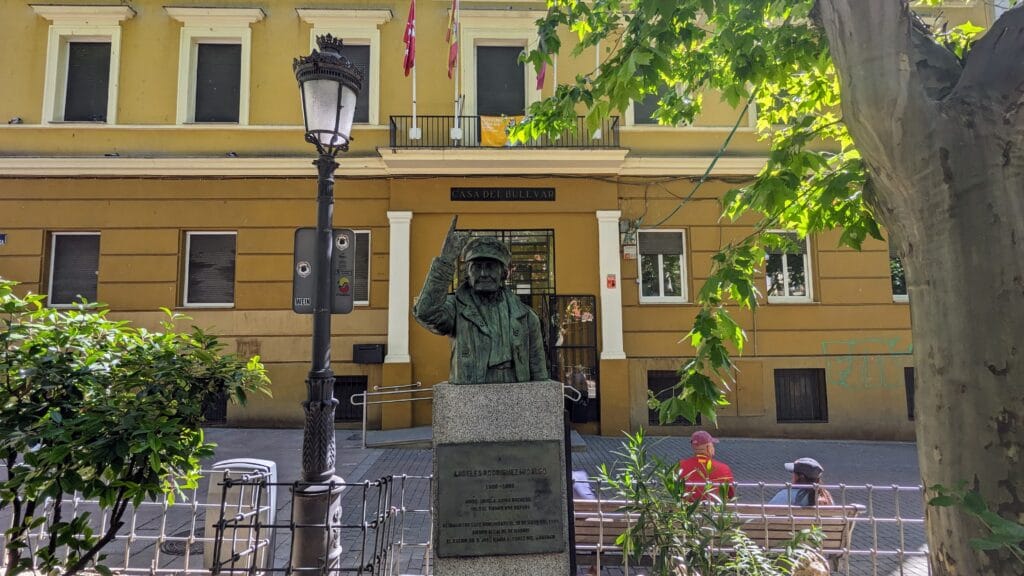
There’s a small market called the Mercado Puente de Vallecas near the boulevard, though it’s more for fruit and veg than somewhere you’d go for a meal or drink. At the far end of the boulevard, there’s a stage where free summer concerts are held. Right beside it stands the statue I’ve been wanting to visit ever since I started this blog. This is the Abuela Rockera: the Rocking Grandma. She was a local icon who used to rock out at concerts with her grandson.
Stop 7: Bar La Bombonera de Vallecas
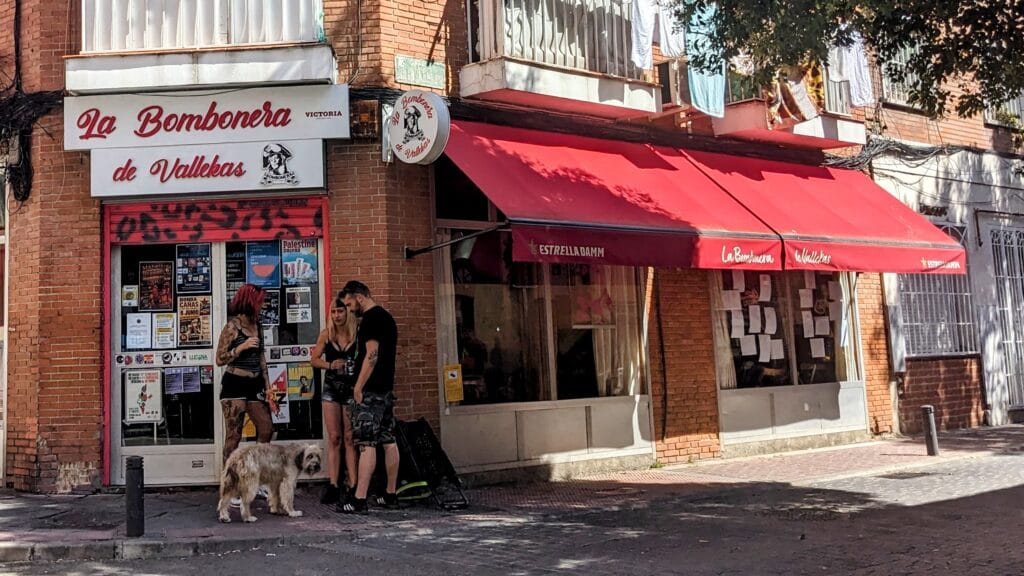
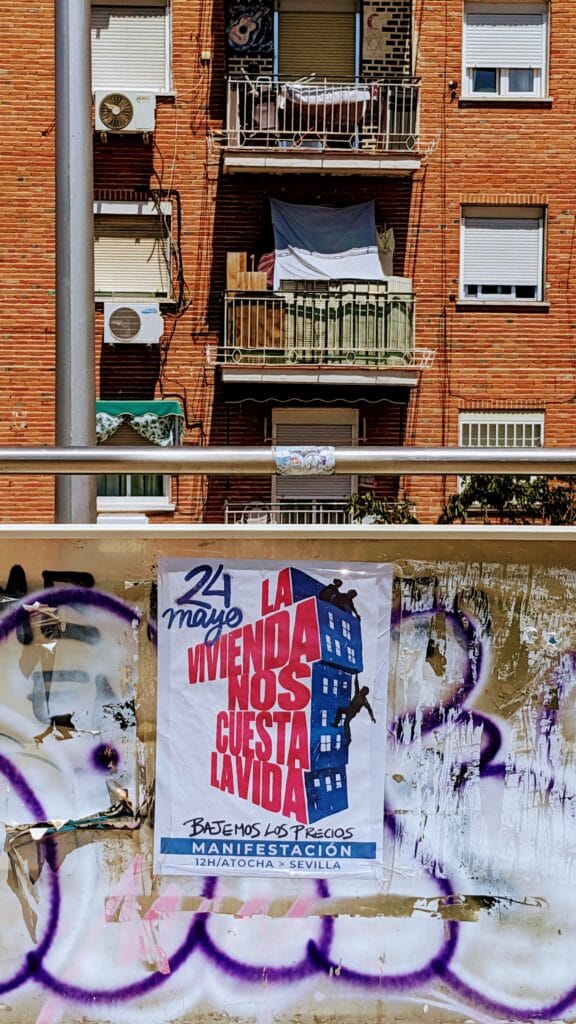
About eight minutes’ walk from the boulevard is neighbourhood institution Bar La Bombonera de Vallecas, an antifa bar with posters against gentrification and in support of Palestine in the window, that encapsulates the political character of Vallecas. I was too pressed for time to go in, but it looked great.
Stop 8: Estadio de Rayo Vallecano
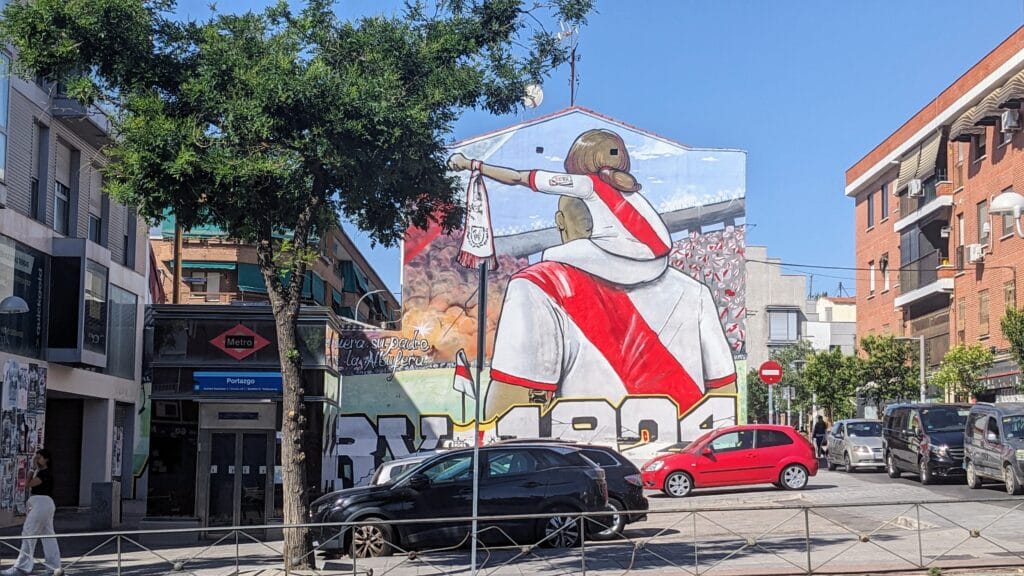
The Estadio de Rayo Vallecano is the home of Rayo Vallecano, one of La Liga’s best-loved clubs and a team whose nickname — el orgullo de la clase obrera, the pride of the working class — tells you everything about their relationship to this neighbourhood. The rayo (lightning bolt or ray of light) in the team name comes from the red stripe that cuts through their logo. Not being a football fan, I wasn’t particularly moved by this sight, but a little South American boy passing by with his grandmother clearly was and began loudly wondering when, if ever, he would get a Rayo Vallecano t-shirt!
Stop 9: Numancia Market — Drinks at La Trinchera
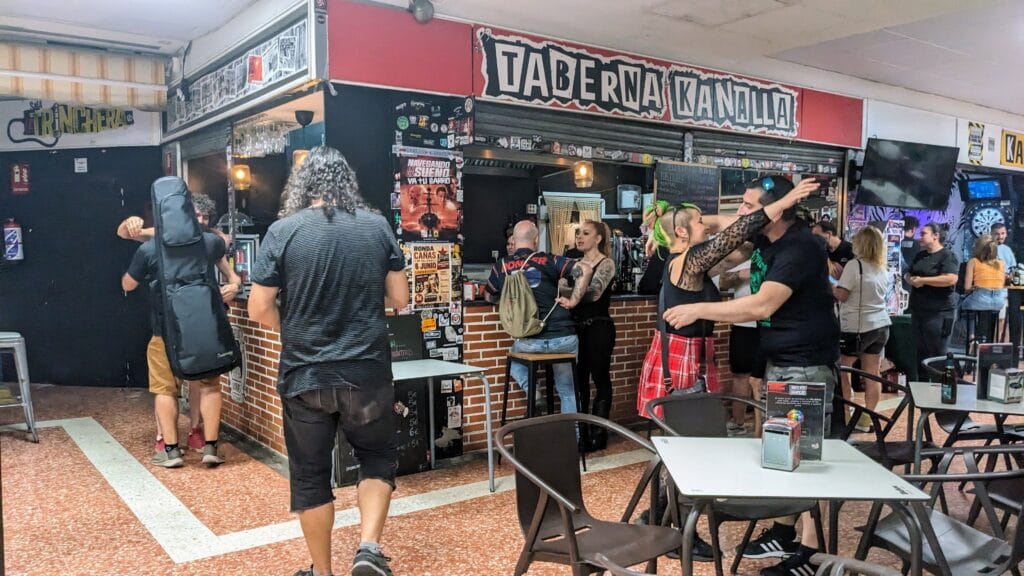
The Mercado de Numancia is a completely different proposition from the Mercado Puente de Vallecas. This is the one my husband has been telling me about for ages: a lively, social hub where people go to hang out, eat, drink, and in some cases dance. I met up with my friend Melissa there.
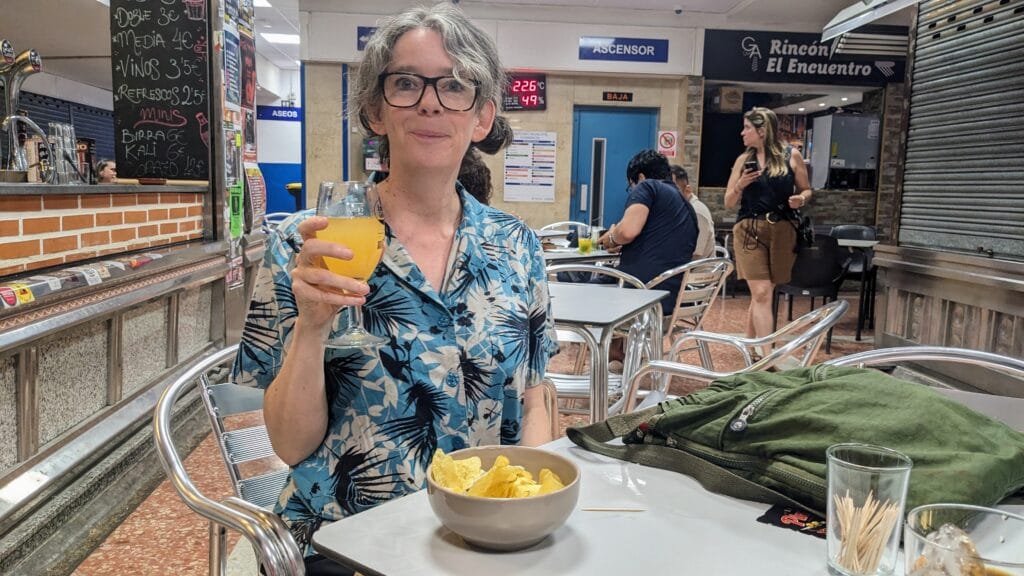
We started at La Trinchera, which is a bar in the market that also has a live venue inside for rock and punk bands. The guy behind the bar was friendly and generous. When we mentioned we were hungry, he gave us a bowl of crisps and anchovies on the house. Melissa had a vermut (vermouth) and I had a clara con limón (essentially a shandy). The music was great and we would have liked to stay longer, but we had tickets for a show.
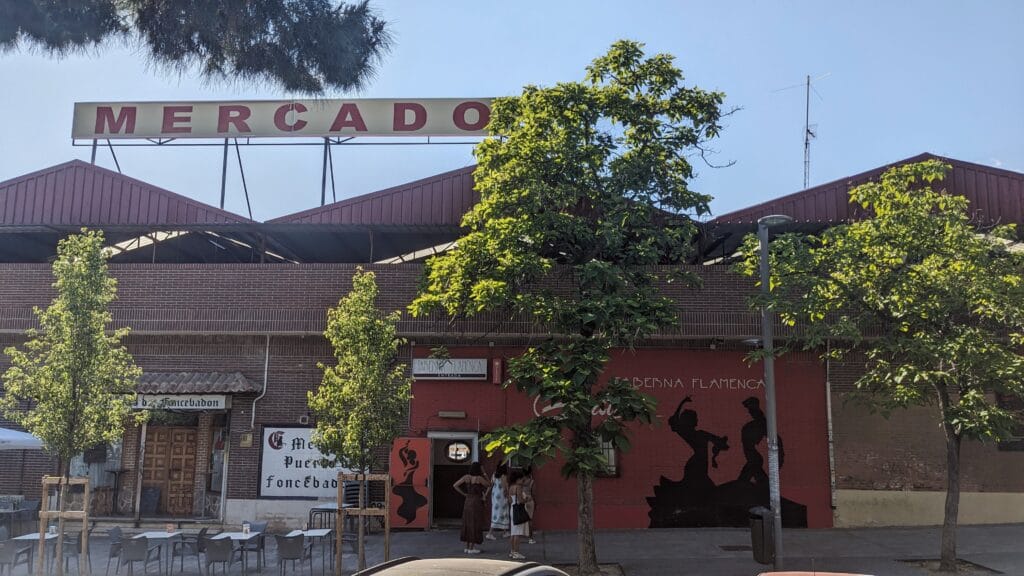
Stop 10: Flamenco at Taberna Flamenca El Cotijo
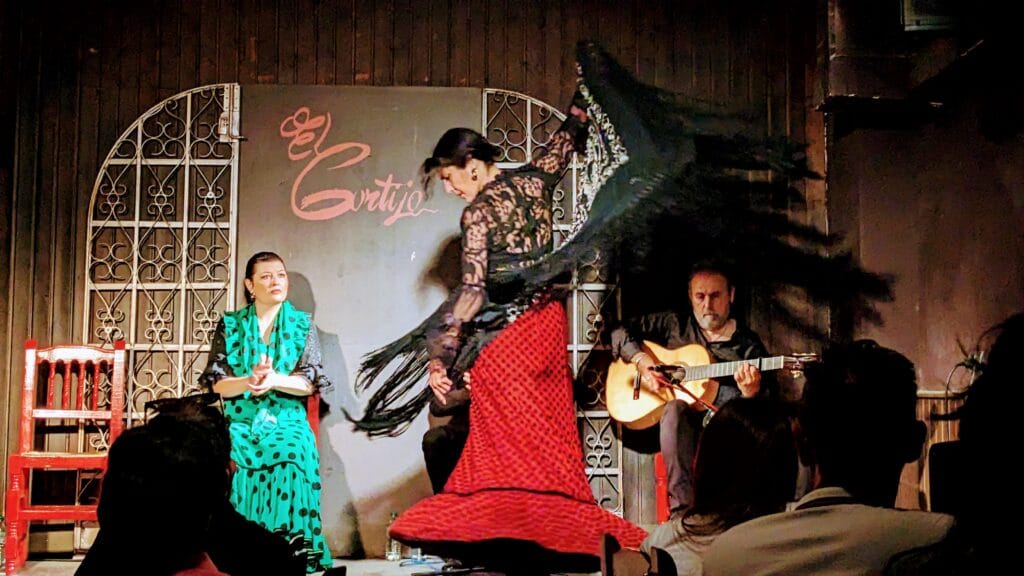
Taberna Flamenca El Cotijo is also inside the Numancia Market, and I cannot recommend it highly enough. This is genuinely one of the best-value flamenco experiences in Madrid. In the centre of the city, you’re looking at €30–40 for a show; here it’s around €19, and the quality — according to Melissa, who has actually studied flamenco — is excellent. I’d take her word over mine on the technical side, but from my entirely amateur perspective, it was spectacular. We had a five-euro tinto de verano (wine and lemonade) each and while that’s a bit pricy, the pour was generous. The show lasted about an hour and fifteen minutes. It’s wise to book in advance, though there were spaces when we visited on a weekend evening.
Just a note for those expecting the ‘authentic’, ‘hidden gem’ flamenco experience: this barely exists in Madrid unless you have contacts that can clue you into underground events. Most shows are touristy, but this one is a good deal, nonetheless.
Stop 11: Dinner at Restaurante Puerto Foncebadón
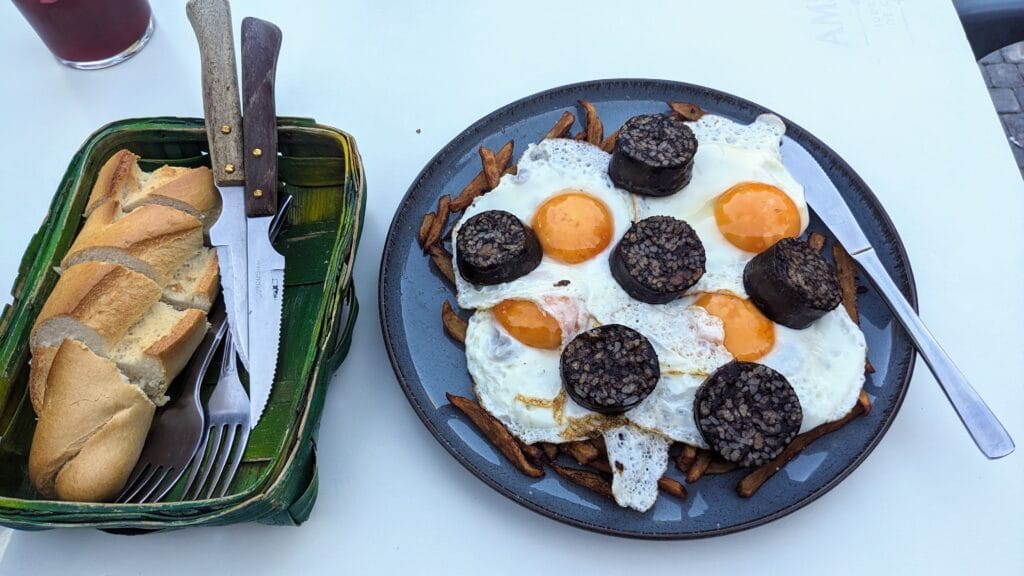
After the show, we came out into the beautiful warm evening and instead of going back into the market, decided to eat on the terraza of the restaurant right next door: Restaurante Puerto Foncebadón. We shared huevos rotos — broken eggs over chips — with morcilla (blood sausage with rice). The chips were not the best I’ve had, but the portion was enormous, the morcilla was excellent. We paid €14 for a plate that was more than enough for two people.
Final Stop: Cerro del Tío Pío — The Seven Hills at Sunset
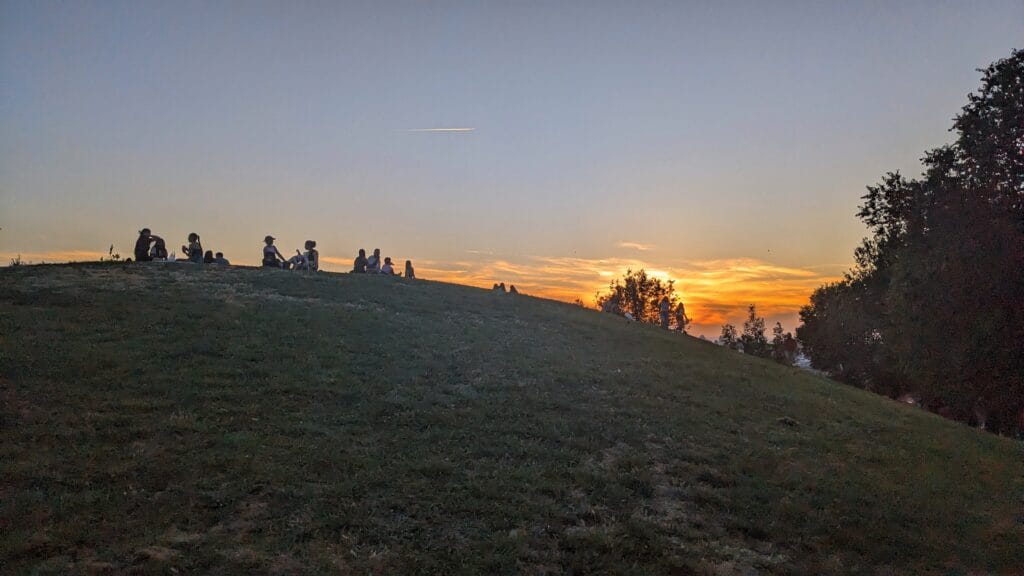
This is the one I’d been looking forward to all day, and it didn’t disappoint.
Cerro del Tío Pío is a park on a hill above Vallecas, locally nicknamed Las Siete Tetas — the Seven Tits — because it’s made up of seven rounded mounds. These are not natural formations: they’re built from rubble. In 1987, the last of Vallecas’s great shantytown clearances took place, and the debris was used to form these hills. Grass has grown over them. And from the top, you get one of the most astonishing views in Madrid: the entire city laid out below you, with the mountains in the distance.
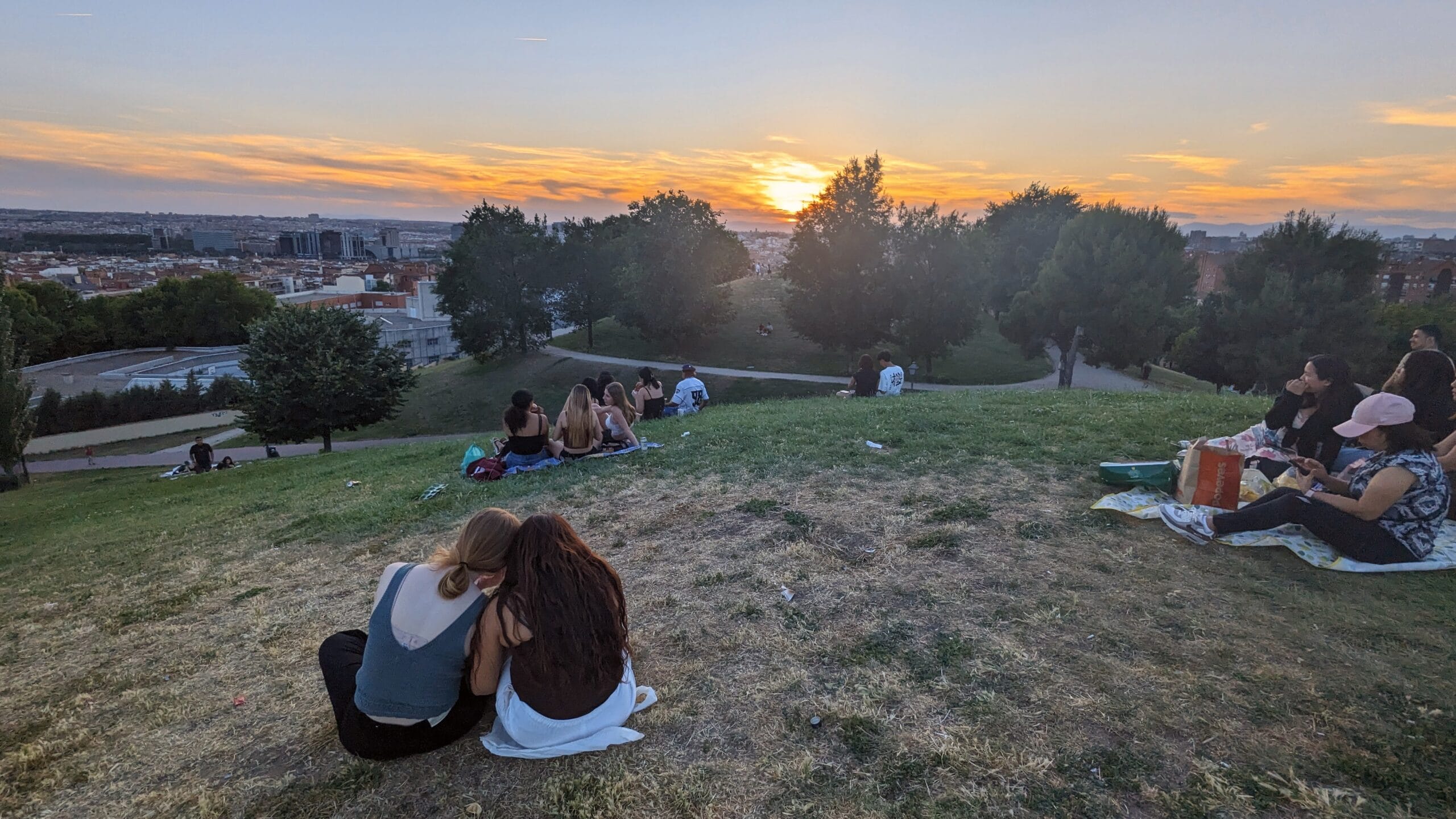
We walked up as the sun was going down, and though we didn’t plan ahead and bring drinks, there were plenty of lateros (people selling cold cans of beer from cool bags) around. There were also couples having a romantic moment everywhere. As the sun went down, stars appeared above and the lights of Madrid began to twinkle below, bringing an end to my fabulous adventure in Vallecas.
Practical Information
Getting there: For the Robert Capa house, take the Cercanías from Atocha to Asamblea de Madrid-Entrevías. For the boulevard and stadium area, take line one to Nueva Numancia. For Numancia Market, use Portazgo metro.
The Batalla Naval de Vallecas: If you’re in Madrid in July, look up this annual giant water pistol fight. It takes place on the second or third weekend of July and is becoming quite the draw.
Budget: This is one of Madrid’s more affordable barrios for eating and drinking. The flamenco at El Cotijo is the biggest single spend at around €19, but everything else is genuinely good value.
Q&A: Your Questions About Puente de Vallecas, Answered
Is Puente de Vallecas safe? Most of it, yes. The area around the Robert Capa house in Entrevías can feel quite rough and shows signs of deprivation — overflowing bins, neglected streets — but I walked through alone during the daytime without any issues. If you’re not comfortable with that kind of environment, you can start the itinerary at the tiled facades on Avenida de Monte Igueldo instead and miss nothing in terms of bars, food, or culture. The rest of the neighbourhood — the boulevard, the market, the stadium area — is perfectly relaxed.
Where can I see flamenco cheaply in Madrid? Taberna Flamenca El Cotijo in the Mercado de Numancia in Puente de Vallecas offers shows from around €19, which is considerably less than the €30–40 you’d pay in central Madrid. Try to buy tickets in advance.
What is the Batalla Naval de Vallecas? It’s an enormous annual water pistol fight held on the second or third weekend of July in Puente de Vallecas. It’s been growing into a proper Madrid summer event. Check the exact dates online before you go.
What is Cerro del Tío Pío, and why do people call it Las Siete Tetas? Cerro del Tío Pío is a park in Puente de Vallecas, and its nickname, Las Siete Tetas, or the Seven Tits, refers to the seven rounded hills that make up the park. These mounds were created from the rubble of the neighbourhood’s shantytown clearances in 1987. Today, they’re covered in grass and offer one of the best sunset views in all of Madrid, with the city stretched out below and the sierra in the distance. It’s free, informal, and genuinely spectacular.
What is Rayo Vallecano and why is the club famous? Rayo Vallecano is a professional football club that plays in La Liga and is based in Puente de Vallecas. They’re known for their left-wing, anti-establishment identity — their nickname is el orgullo de la clase obrera (the pride of the working class).
What is the Robert Capa house in Vallecas? It’s a building at Calle Peroncel 10 that photographer Robert Capa photographed in 1936 after the first bombing of Madrid at the start of the Civil War Siege. The house was pictured with children outside, riddled with shrapnel. Remarkably, it still stands. There have been plans to convert it into a museum dedicated to Capa’s work, but these have been altered by the current local council, a decision that has caused considerable controversy. The exterior has been painted with recreations of Capa’s photographs and is worth visiting even though the building is currently closed.