If you’re finishing up a visit to the Palacio Real and walk straight past the Royal Armoury without going in, you’re making a serious mistake. I know, I know — by the time you’ve done the palace, you’re tired, your feet hurt, and the café is calling. But trust me on this one: the Royal Armoury is one of the most extraordinary and underrated museum experiences in Madrid, and the good news is that most visitors do skip it, which means you’ll practically have the whole remarkable place almost to yourself.
This guide to the Royal Armoury at Madrid’s Palacio Real covers everything you need to know before you visit — the history, the highlights, how long to spend there, and the stories behind the armour that make the whole thing come alive. And if you want to hear even more, you can listen to the full episode on the Making of Madrid podcast, which I recorded after going on a private guided tour with Álvaro Soler, the curator of the Royal Armoury.
What Is the Royal Armoury?
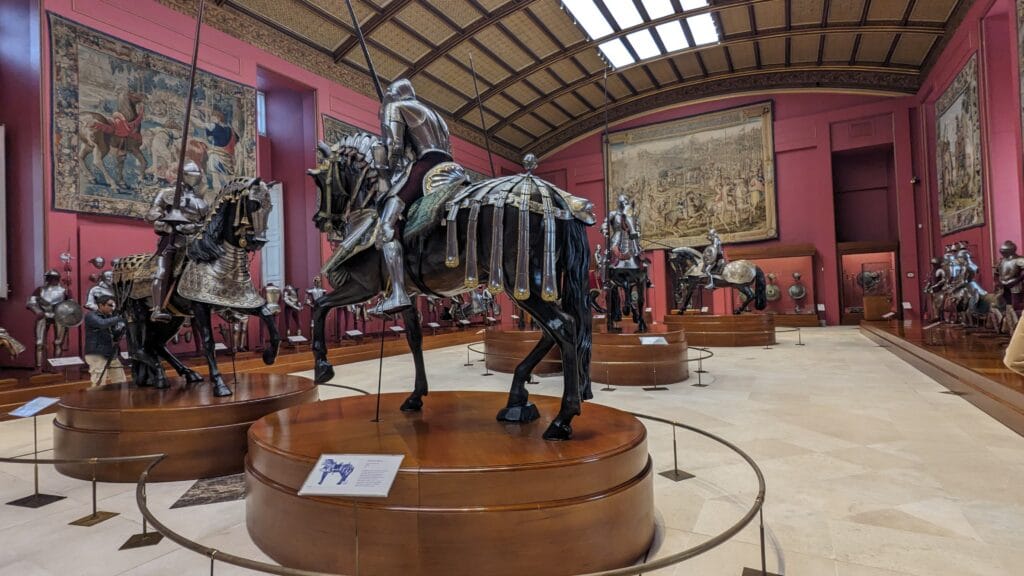
The Royal Armoury (Real Armería) sits at the far end of the courtyard as you exit the Palacio Real. It houses one of the finest collections of arms and armour in the world — a collection that began with Carlos V, Holy Roman Emperor and Charles I of Spain, arguably the most powerful man of his time.
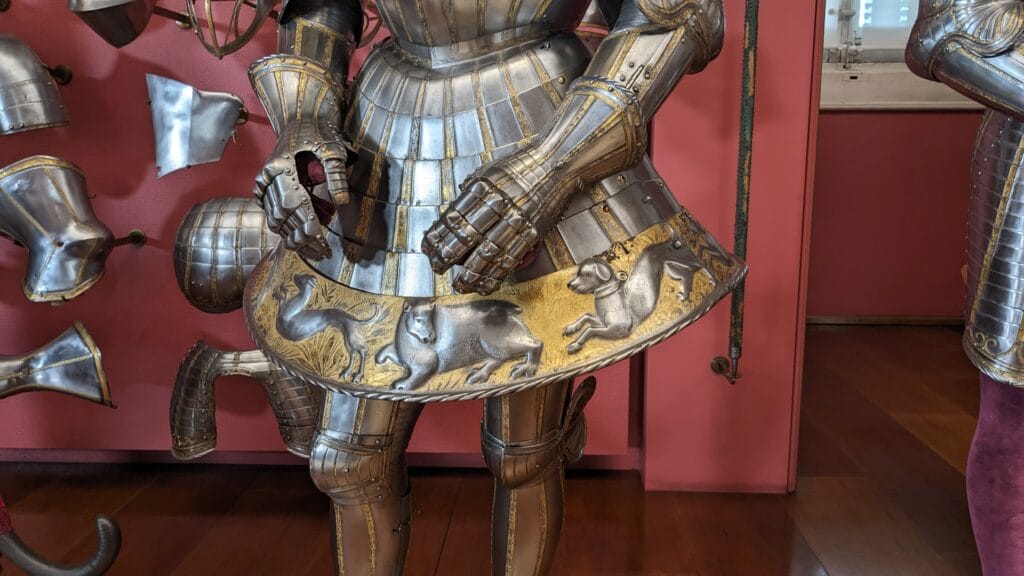
Carlos ruled over an extraordinary sweep of territory: the Iberian Peninsula, the Kingdom of Naples, Sicily and Sardinia, the Burgundian Low Countries, much of Northern Italy, and — crucially — overseeing the colonisation of South America. With that level of wealth and ambition came a collection of armour that is almost incomprehensibly rich. What makes it special even for people who aren’t particularly into military history is that this armour is gorgeous; the objects themselves are works of art — hunting armour covered in beautifully engraved animals and battle gear edged with beautiful detailing.
The New Lighting
Before we get into the highlights, I have to mention the recent refurbishment. The armoury was closed for over a year, and when it reopened, the big change was the installation of a new overhead lighting system. In the past the space was rather dim and gloomy. Now, the lighting picks out every engraved detail, every inlaid decoration, every rivet and flourish. It has genuinely transformed the experience. When I visited for the reopening I was struck by how much you can now see that you simply couldn’t before, so give yourself at least 45 minutes. Or, if you’re a military enthusiast, at least an hour.
Highlights of the Royal Armoury Collection
Ferdinand of Aragon and the Last Emir of Granada
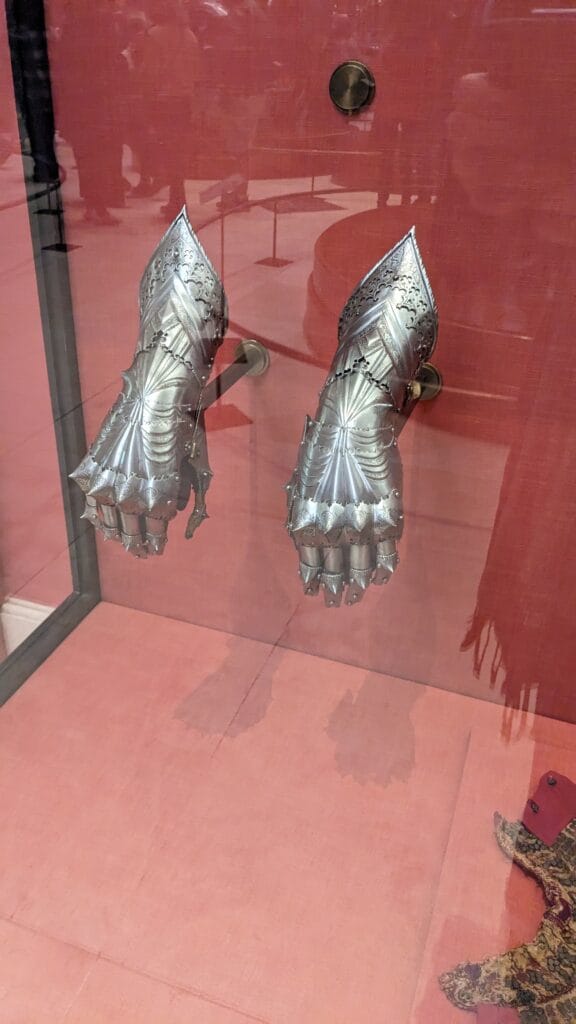
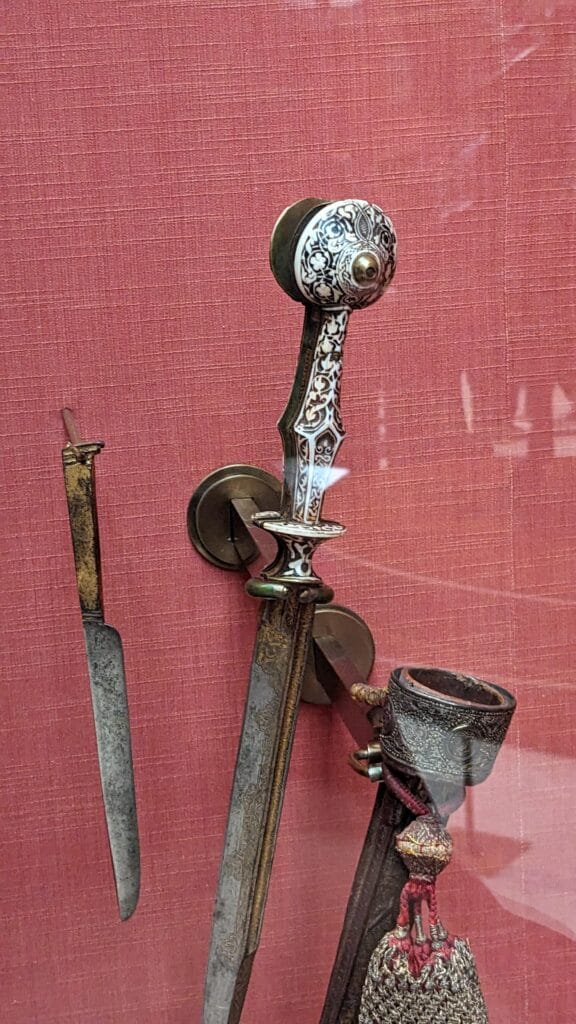
Near the entrance is a display that tells the whole story of how Spain became Spain. Here you’ll find the medieval armour of Ferdinand of Aragon — including his gauntlets — and right alongside it, a Nazari dagger that belonged to Boabdil, the last Emir of Granada. Ferdinand took this as a trophy after the conquest of Granada in 1492, a campaign that marked the end of a long campaign by the Catholic Monarchs (Ferdinand and his wife Isabel I) to retake the remaining Muslim territories of the Iberian Peninsula. The dagger is a genuine work of art in its own right: an ivory handle with intricate floral patterns. Beautiful and yet filled with the poignancy that marks the end of Al Andaluz.
Carlos V: The Heart of the Collection
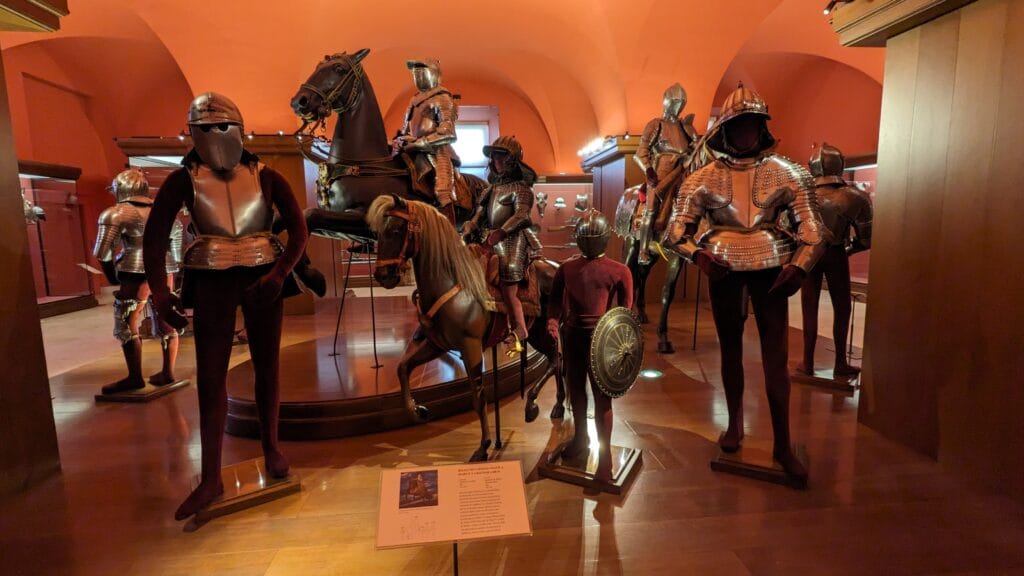
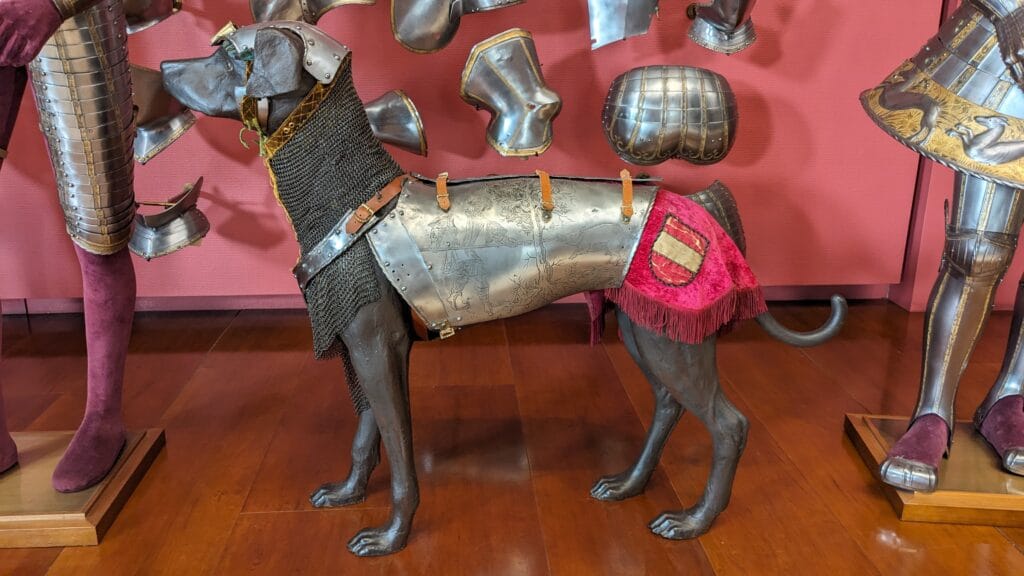
The collection really explodes with the reign of Carlos V. He spent a fortune on armour made by the Helmshmeid family, who would go on to make armour for all of his descendants too. Some of it is mounted on human figures and horses, so you can see exactly how it would have looked on the battlefield. The hunting armour alone, with its carved animals and exquisite detail, is worth the visit. Keep a particular eye out for the suit of armour made for his dog, which is just adorable.
If you’re visiting the Galería de Colecciones Reales (which sits right next to the armoury and is available on a joint ticket), you can also see the famous Titian portrait of Carlos V at the Battle of Mühlberg, along with the actual suit of armour he wore on that occasion.
Philip II: The King Who Made Madrid a Capital
Carlos’s son Philip II is the monarch who established the royal court in Madrid, effectively turning it into the capital city. He was also a passionate art collector — it was Philip who really began amassing the collection that would eventually become the Prado, acquiring works by Hieronymus Bosch among others.
His second marriage was to Mary Tudor of England. The couple was wed at Winchester Cathedral in 1554. Philip had a suit of armour made specially for the occasion, though in the end, he did not walk down the aisle in battle dress (surely a faux pas!) but wore white cloth-of-gold brocade to coordinate with his bride. (The armour is in the collection; the marriage, as history records, did not end well — Mary died, Elizabeth came to the throne, and that connection between Spain and England eventually fell apart in the disaster of the Spanish Armada.)
One of the pleasures of this collection is that alongside the armour you’ll find reproductions of portraits showing these kings wearing the actual pieces on display beside them. Standing in front of Philip II’s armour with his portrait next to it is a surprisingly moving experience — cloth invitably decays, but metal endures, giving you a real sense of proximity to these figures.
Don Carlos and the Black Legend
Philip II’s first wife was his cousin María Manuela, and their son was Don Carlos, Prince of Asturias — one of the more disturbing figures in Habsburg history. He was born with one leg longer than the other and an equally uneven temper. The Habsburg jaw — a consequence of generations of intermarriage — was prominently on display.
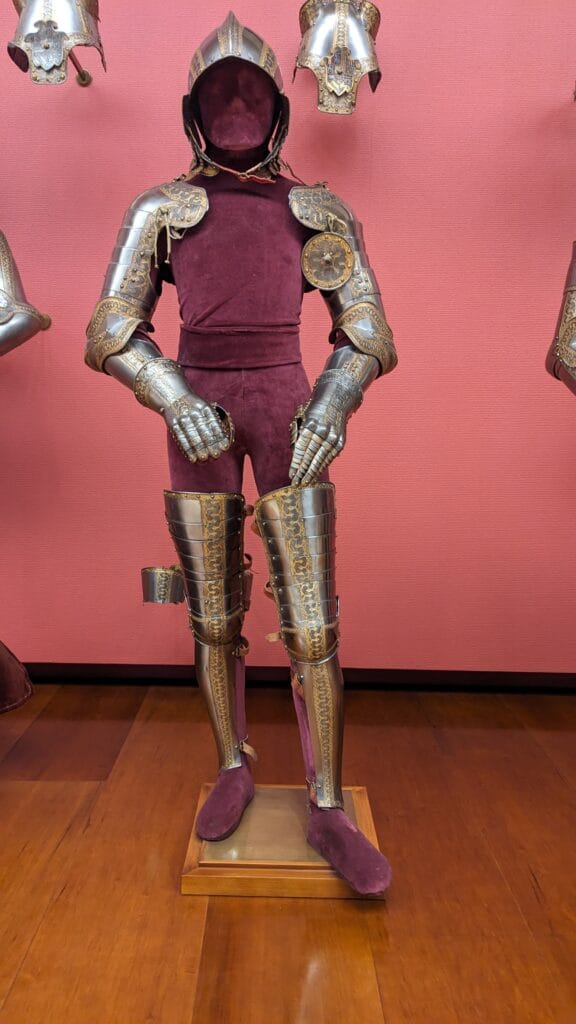
Don Carlos received his first suit of armour at the age of 13, specially adapted for his unusual proportions. But he was eventually barred from succession after horrifying the court with violent rages. He attempted to stab the Duke of Alba (Philip’s right-hand man) and conspired with Protestant enemies in the Low Countries. When he tried to shoot his uncle, Don Juan of Austria, a servant had thoughtfully emptied his guns beforehand. Philip had him imprisoned; Don Carlos died in custody on 24 July 1568.

The Protestant north ran with this story, painting Philip II as a monstrous king who had his own son murdered. This narrative became part of what historians call the Black Legend — a propaganda effort by Spain’s enemies. You can see Don Carlos’s armour in the collection, along with a portrait of him dressed in fur-trimmed finery wearing a smug look on his face not unlike that worn by Game of Thrones’ King Joffrey!
Downstairs: Don’t Miss the Lower Level
Here’s something a lot of visitors get wrong: the downstairs is as large as the upstairs. By this point in your visit you may be flagging, but push on. There is genuinely extraordinary stuff down there.
The Samurai Helmet
One of the most arresting objects in the entire armoury is a 16th-century Japanese samurai helmet (kabuto). With metal ears attached to the sides, it’s rather odd-looking. This was a gift from the Tenshō Emperor to Philip II in 1584 — soon after Japan entered the Sakoku period of self-imposed isolation and diplomatic relations all but ended.
Though the helmet was badly damaged in a fire in 1884, the makers of Assassin’s Creed Shadows asked to recreate it for the game and made a reproduction based on old photos, which they gave to Patrimonio Nacional. At the time of writing the original was on temporary display in the Galería de Colecciones but is due to return to the Armoury to sit alongside the reproduction.
The Battle of Lepanto: Ali Pasha’s Helmet and Gauntlets
Downstairs you’ll also find trophies from one of the most significant naval battles of the 16th century: the Battle of Lepanto (1571). The Pope called on Catholic powers to push back against the Ottoman Turks, and the Spanish fleet — commanded by Don Juan de Austria, the illegitimate (but acknowledged) son of Carlos V — won a decisive victory. Part of the spoils on display are the helmet and gauntlets of Ali Pasha, the commander of the Turkish fleet, along with shields and banners.
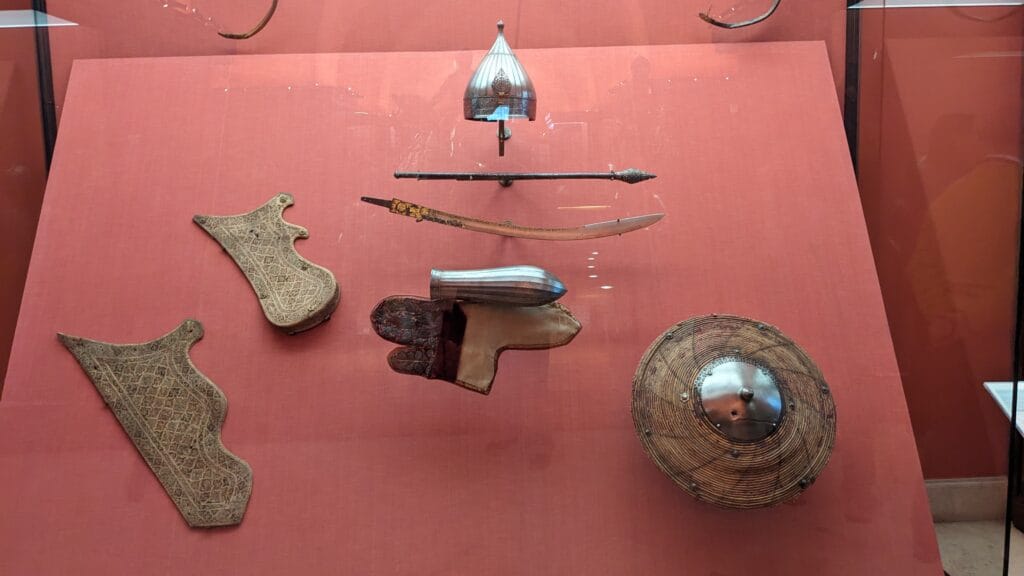
There’s a Cervantes connection to this battle. The author of Don Quixote had fetched up in Italy around this time, probably running away from the law after badly wounding an opponent in a duel in Madrid. The punishment he was escaping was to have his right hand chopped off. To redeem himself, he signed up to fight with the Spanish fleet. He was ill on the day of the battle but insisted on going above deck anyway and was shot. He lost the use of his left arm — his writing hand was his right, so, while a kind of poetic justice was served, he was still left able to write Don Quixote in later life.
The Madrid Arquebuses
One of the things curator Álvaro Soler was most excited to show journalists was a collection of Madrid-made arquebuses (arcabuces) — long matchlock rifles that date from the reign of Carlos III, making them the first Bourbon-era pieces to go on display (they’ve recently been brought out of storage) in the armoury.
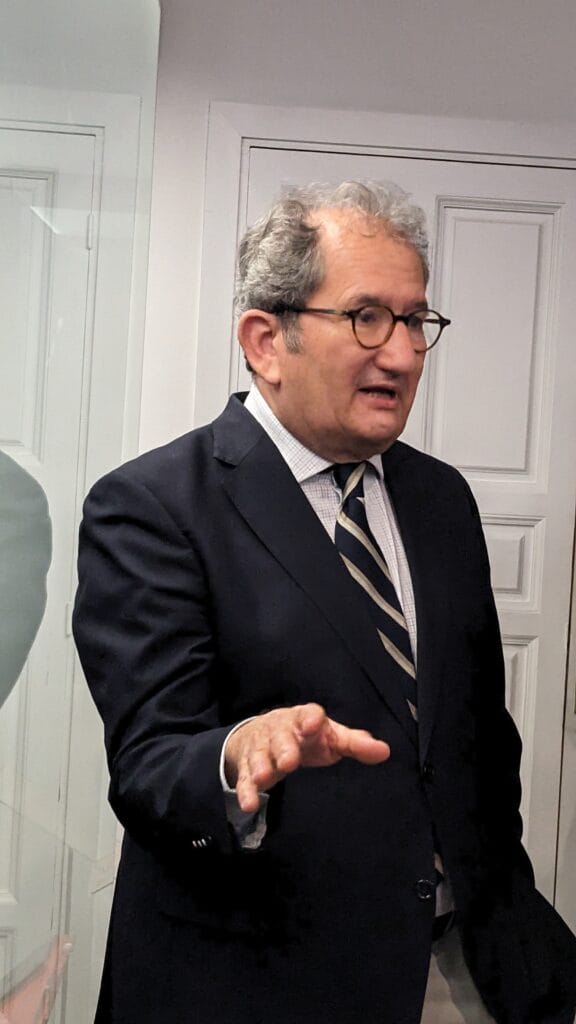
Madrid’s iron bullets were, apparently, famous throughout the world for their robustness — a special metalworking technique allowed them to withstand more gunpowder and stay intact under greater pressure. The rifles themselves are inspired by French designs but manufactured entirely in Madrid, and they are visually stunning.
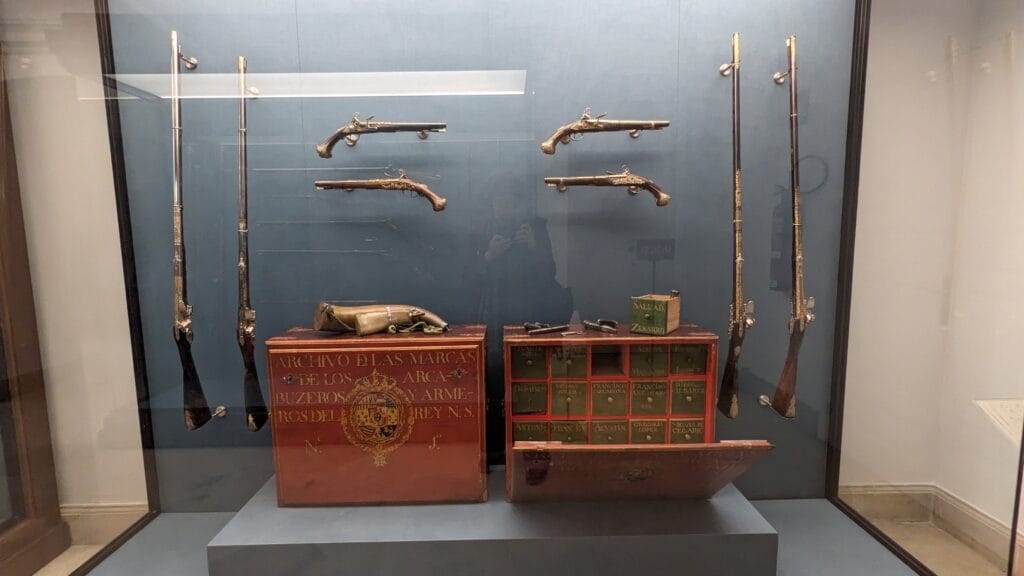
All of this came to an abrupt end when French troops looted the Royal Armoury during the Peninsular War, taking 400 weapons and destroying much of what they couldn’t carry, making the display in the armoury all the rarer.
Practical Tips for Visiting the Royal Armoury
- How long to allow: At least 45 minutes; an hour is comfortable if you want to take it in properly.
- When to go: Before or after your palace visit. Most people are tired by this point and skip it — which means you get it blissfully quiet.
- Joint ticket: Consider combining your visit with the Galería de Colecciones Reales, which is right next door. It will take up most of a day if you do both, but it adds enormous depth to the story — including the armour Carlos V’s wore for his Titian portrait and works by Caravaggio and Velazquez.
- Two floors: Do not leave without going downstairs. It is just as large as the ground floor.
- Free/discount days: Check the Palacio Real website for current pricing and any free entry periods for EU residents.
Q&A: Your Questions About the Royal Armoury at Madrid’s Palacio Real
Is the Royal Armoury included in the Palacio Real ticket? Yes, the Royal Armoury is included in the standard Palacio Real admission ticket. You’ll find it as you exit the main palace building.
How long does the Royal Armoury take to visit? Allow at least 45 minutes to see the collection properly. It has two full floors — many visitors don’t realise the lower level exists and miss half the exhibits. An hour gives you a comfortable, unhurried visit.
Is the Royal Armoury worth visiting? Absolutely. It holds one of the finest collections of arms and armour in the world, spanning the reigns of Ferdinand of Aragon, Carlos I, Philip II, and beyond. Even visitors with no particular interest in military history tend to find it compelling — the armour is extraordinarily beautiful as well as historically fascinating.
What is the most famous object in the Royal Armoury? It’s hard to pick one, but the 16th-century Japanese samurai helmet (kabuto) gifted to Philip II in 1584 is one of the most talked-about pieces. Carlos V’s armour — particularly the suit made for his dog — also tends to stop visitors in their tracks.
Can you visit the Royal Armoury and the Galería de Colecciones Reales together? Yes, there is a joint ticket available. The Galería de Colecciones Reales sits right next to the armoury and adds significant context to the collection. Be aware that doing both thoroughly will take most of a day.
Is the Royal Armoury crowded? Less so than the main palace. Because many visitors are tired by the time they leave the palace and skip the armoury, you will generally have considerably more space and peace here than in the main building. It’s one of the quieter spots in what can be a busy tourist area.
Who made the armour in the Royal Armoury collection? Much of the most significant armour was made by the Helmshmeid family, a dynasty of armourers who worked for Carlos V and his descendants over several generations. The Madrid-made arquebuses on the lower floor represent a later tradition of Spanish craftsmanship, produced during the reign of Carlos III.
Was Cervantes really at the Battle of Lepanto? Yes. Miguel de Cervantes fought at the Battle of Lepanto in 1571 and was shot during the engagement, losing the use of his left arm. He went on to write Don Quixote in his old age with his right hand intact. The armoury’s Lepanto trophies — including Ali Pasha’s helmet and gauntlets — connect directly to this moment in literary history.
Has the Royal Armoury been recently renovated? Yes. After being closed for over a year, the armoury reopened with a new overhead lighting system that dramatically improves the visibility of the collection’s fine details. The renovation also brought previously unseen Bourbon-era arquebuses out of storage and onto permanent display for the first time.