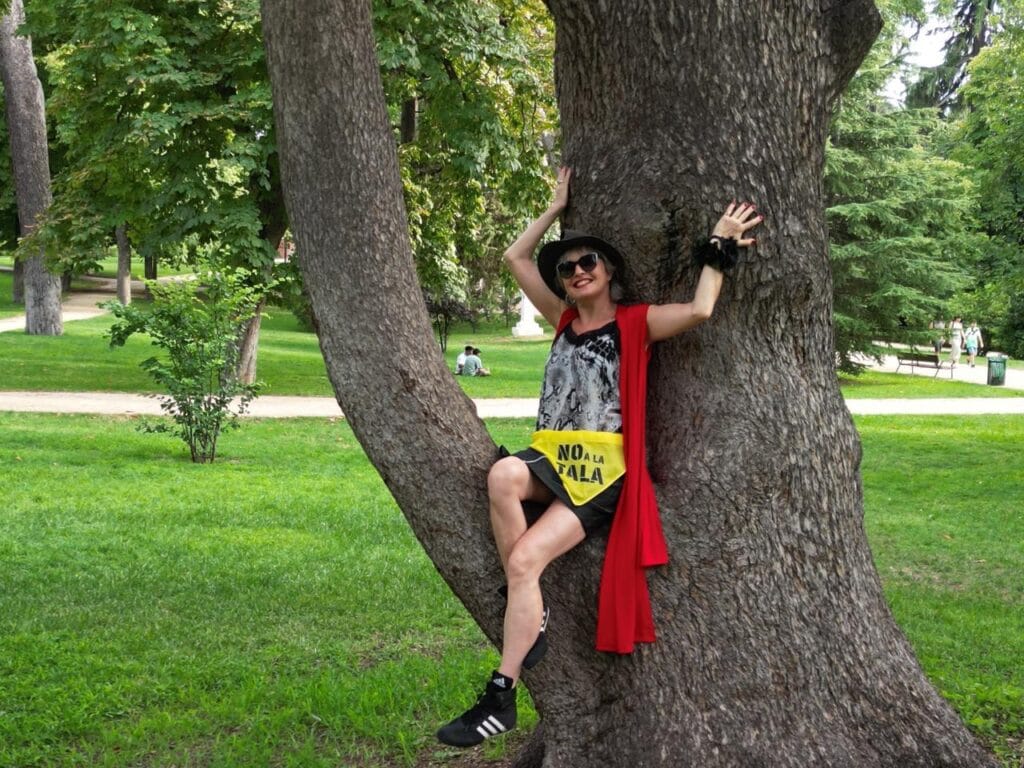
Madrid suffers from one of Europe’s worst heat island effects, and the situation is getting worse. Rather than tackling this problem by planting trees, the local government has been doing the opposite—scrapping plans to add greenery and actively removing mature trees from key public spaces like Plaza Santa Ana and Arganzuela Park. I spoke with musician and activist AmyJo Doherty about the “No a la Tala” (No to Logging) movement and the fight to save Madrid’s green spaces from development projects that prioritize tourism and construction over the city’s livability.
AmyJo has been living in Madrid for 21 years and has become a vocal figure in the movement against tree removal, using both her music and activism to raise awareness. In this interview, we discuss the controversial metro expansion, the removal of century-old trees, the upcoming Formula One circuit that has already wiped out an urban olive grove overnight, and the broader gentrification of Madrid’s neighbourhoods. She also shares what residents and visitors can do to get involved in this crucial fight.
Key Points
- The Metro Expansion in Arganzuela: The new metro line was originally planned on a route that wouldn’t require cutting trees, but the design was moved into a park to avoid logistical complications with the main road. This change means destroying mature trees that have been part of the neighborhood for decades.
- Legal Issues: EU law states that if viable alternatives exist for a development project, proceeding with tree removal is illegal. A delegation of Madrid residents took this to Brussels, but construction began anyway.
- Plaza Santa Ana Tree Removal: Trees were cut down ostensibly to repair an underground car park and expand it further. The removal means eliminating shade and community gathering space in one of Madrid’s most central neighborhoods.
- Temperature Impact: Removing trees can increase local temperatures by up to three degrees—a massive difference when summer temperatures already reach 42°C.
- The Formula One Circuit: Ayuso’s government plans to build a Formula One circuit in the north around Barajas. In the summer, workers removed a centuries-old olive orchard in the middle of the night without warning. Valencia’s experience with a similar project resulted in massive public debt with few of the promised jobs.
- Matadero Bus Station: Plans to build a massive bus interchange at Matadero will destroy centenial trees, though a historic water tank will be preserved.
- Concrete Replaces Greenery: When trees are removed, they’re replaced with concrete, which absorbs heat during the day and releases it at night, making summers even more unbearable.
- Hostile Architecture in Sol: When Sol was renovated, plans to plant trees were scrapped in favor of concrete and “benches” too hot to sit on—design that discourages people from lingering and encourages them to shop instead.
- Gentrification and Community Loss: Central neighborhoods are being transformed to prioritize tourists over residents. The lack of shade and community spaces is actively driving out long-term residents.
- Replanting Promises Are Hollow: The government claims it will replant trees elsewhere, but these trees rarely thrive. They’re often planted far outside the city in areas with poor maintenance.
- Getting Involved: Attending protests, following activist accounts on social media, and sharing information with others is crucial. Hashtags to follow: #noalatala #VecinosContraLaTala
- Activist Groups
- Ecologistas en Acción (@ecologistas_madrid)
- Greenpeace (@greenpeace_madr)
- Stop F1 Madrid @stopf1madrid
- FRAVM (Federación Regional de Asociaciones Vecinales de Madrid)
- XR Madrid @xrmadrid_
- Support Local Over Airbnb: Choosing local accommodation over Airbnb helps prevent the conversion of residential spaces into tourist apartments, which accelerates gentrification.
Interview Transcript
Felicity: Hello. Madrid suffers from one of the world’s worst heat island effects, and this makes our increasingly hot summers increasingly difficult to bear. Now, the obvious answer is to plant trees, but rather than do that in the city centre, our local government has actually been scrapping plans to plant trees and has been removing trees from places like Plaza de Santa Ana or the park of Aguanzuela by the river. So, why are they doing this? Well, to answer this question, I’m going to talk today to activist Amy Jo Doherty, who is a musician, and she’s been really involved in the movement No a la Tala to save the trees in Madrid. Hello, Amy Jo.
AmyJo: Hi. How are you today? I’m great, thank you. The sun’s shining and it’s a lovely day in Madrid. Thank you so much for coming on the podcast.
AmyJo: Oh, well, it’s a pleasure to be here. Thanks for inviting me. And hello, everyone that’s listening.
Felicity: Yeah. So, before we get stuck into the thorny topic of the trees, I should introduce you. And I know Amy Jo because I saw her leaping around Retiro Park at a friend’s daughter’s birthday party. And so, you’re a musician, is that right?
AmyJo: I am, yeah. I use that.
Felicity: So, tell me about that.
AmyJo: Well, it took me a long time to use that word because I’m not a trained musician. I never had classes. I was an infant’s teacher for a long time, but I’ve always played the guitar and I’ve always written songs. And I ended up forming my first band, which was called the Ezra Beats, and a mum that was looking for… I was running a group called Bags of Fun, which was all about… it was a mums and toddlers group. But it was a bit of a concept that wasn’t quite… It was a bit of a concept that wasn’t quite fitting for Madrid at that time. And she said, what we need here, Jackie Daly, she said, we need music that mums can come and sing nursery rhymes in English and the sing-alongs that you get in the UK. And there was nothing like that here. So, I used to get so nervous. I used to rehearse and now you see me, yeah, I’m leaping around. And in fact, I’ve just come from Retiro. I’ve still got my weekly music class and I do concerts all over Madrid. And at the same time that I was playing for kids, I started playing for adults as well around open mics in Madrid. And this was all about, I don’t know, 18 years ago now.
Felicity: But people can hire you as an entertainer, right?
AmyJo: Yeah, yeah. I do kids’ birthday parties. Well, and also I’ve just… I do for older kids too. I’ve just done a wedding in August. So, yeah, I’ve got something for all ages.
AmyJo: How can people find you? Do you have an Instagram or a website?
AmyJo: I do. I have a… if it’s for the kids’ stuff, which I do normally up to five or six years old, it’s called Shake Rattle Roll Madrid. And you can find me. I’ve got a website and I’m on Instagram. And then for my own stuff, also covers and my own songs, I’m either piglady72 on Instagram or I’ve got… If you just look up Amy Jo Doherty, I’ve got… Because I’ve got so many different profiles. I’ve got my band Amy Jo doing the Spangles or… But yeah, put my name in and you’ll find me.
Felicity: All right. Well, we’ll put some links in the description. Oh, brilliant. Thank you. People can get you. And you must have got into music maybe a little bit because your brother’s a very famous musician, right?
AmyJo: Yeah, well, I think as a musician myself, that can kind of put you off at first from getting into the main circles. But, I mean, we were brought up with listening to a mix of rock and roll and Motown. My mum’s really into Motown. And she loves Barry White and Marvin Gaye. So we had all that soulful stuff on the one side. And then my dad was really into the Kinks and Steely Dan and obviously the Rolling Stones. And they both loved the Beatles. So although they didn’t play, we always had music in the house. We were sent to piano lessons. Yeah, and Peter, since he started playing the guitar at 16, he never put it down, actually. He just wanted to be a rock and roll star.
AmyJo: Yeah. And he is. So.
Felicity: Okay. Let’s move on to the subject of today, which has been a subject that’s been rumbling on quite painfully for a while. And that is, I suppose, should we say, Noah LaTala? Noah LaTala. Yeah. And I first heard this phrase, Noah LaTala, at a protest in Arganzuela, which is by the river, where they were going to build a, well, they are building a metro station. And I learned that Tala means logging. And they’re protesting the cutting down of trees. So can you explain a little bit about the context of that protest?
AmyJo: Yeah, well, they’ve got this new line that, you know, a lot of us are saying it’s basically to get the tourists in quicker. Get them direct to the center from the airport. And Arganzuela was where I think most of the damage was done and down by the river. Basically, it’s just a bit mind boggling because, you know, that area, Delicius, you’ve got so many metro stations. You’ve got Atocha, which is also train and Cercanillas, which are the middle distance trains. You’ve got Delicius itself. You’ve got Palos de la Frontera. Embajadores is really close by. There’s so many buses that go through there. And it’s like, do you really need, we all know if we live in Madrid that the metro system is really good, you know, and you’ve got the Cercanillas too. So, you know, it brings the question to mind, why do we need another metro line? It’s certainly not for the people that live in here, I don’t think.
Felicity: Or even there was the phrase Metro sí, pero no así. Yes to the metro, but not like this. Because what had happened was there were plans to put the metro. Metro in an area that wouldn’t require cutting down trees. And then they decided, I think that, you know, the logistics of it were difficult with the main road running through. So they moved it into a park. So therefore they would have to cut down trees.
AmyJo: Yeah. Yeah. I think at the time there was lots of plans and the plans were shared. The so-called plans were shared by Ayuso’s government. And there was a lot of options. It’s presented by people that were neighbors or, you know, interested in saving the trees and keeping a greener Madrid. Because another thing that you’ll hear them shouting is that if there’s options, then it’s illegal. And actually a group of neighbors took this to Brussels. They went to Brussels. A lot of the manifestations, they were collecting money because this is all basically neighbors. And people that live in Madrid doing this out of their own pocket.
Felicity: Hi. Just a little note here to say that Amy Jo refers to manifestations, which is a false friend in a way. It shows what happens to a lot of us who’ve been out here for a long time and start using Spanish words as English ones. She means protests because manifestaciones, which is maybe a new word to some of you, means protests. And she means protests in English. And also when we talk a lot about locals, we tend to talk about vecinos, which is neighbors. So just in case you were thrown by that, I thought I’d put this little explainer in.
AmyJo: So they sent a delegation to Brussels to say, look, this is what they’re saying. They are the possibilities. But we’ve had a look as well. They presented other ideas. And Brussels actually said, well, if there are alternatives, then it’s illegal. But by the time they got back from Brussels, apparently, they’d already started drilling and digging and talando. You know, they did manage to save one park right by Delicia’s El Jardin. I think it’s called Jardin de Palestina, which is, you know, kind of beautiful. They saved that tiny park. But yeah, parks have just been, you know, demolished. There was the talk that they’re going to re-put the trees back. But we all know that that’s a load. It’s a load of rubbish. And there’s such stress caused to these trees. You know, it’s not going to be the same.
Felicity: Yes, that’s an important issue. They talk a lot about replanting. And I think that has been debunked because a lot of these trees, when they’re replanted, don’t thrive and die. Or they put in, you know, they say for every tree cut, they’ll plant another tree. But generally…
AmyJo: In their personal gardens, probably. Out in Mahadonda.
Felicity: Or in these massive areas outside of town. And I’ve heard they’re not very well cared for and they don’t thrive. So, yeah.
AmyJo: These barrios, I mean, I live right in the center in Lavapiers. And, you know, the trees are past their best, perhaps. They’re doing the best they can. But in Argenzuela and Delicia’s, you know, you had big, beautiful old trees. Some of them were 60 years old, 70. You know, a lot of these neighbors that you’ll see are pensioners. And they were kids when these trees were planted. Or the trees were already there. It’s so much part of a neighborhood, you know. And people forget that Madrid is so hot. It’s one of the hottest cities in Europe. And, I mean, there was another area that was and is a big problem is Plaza Santa Ana. And one of the last demonstrations there, they had some scientists that came and spoke about, you know, the difference in degrees could be up to three degrees. And three degrees when you’ve already got 42 degrees in the summer is a lot. You’re talking about massive differences. You know, there’s and apart from the shade and apart from the oxygen and apart from the birds, where do the birds go? The birds, you know, it’s so hot here during the summer. And it’s just.
Felicity: They just make it worse. Yes, it compounds the heat island effect, which is a big problem.
AmyJo: And, of course, what they do is they replace it all by concrete. And we all know if we’ve spent an August in Madrid, the feeling at night is that it’s even hotter because it’s just like the concrete sucks up the heat and seems to spew it out at night. It’s unbearable. And the trees, you know, help alleviate that somewhat.
Felicity: Yeah, so there were plans to put in trees. When they renovated Sol and they decided not to plant them. And now what we’ve got is this kind of hostile architecture that’s all concrete.
AmyJo: Benches, you know, that are too hot to sit on. It’s like they don’t want people hanging around. You know, they want the people in the shops buying overpriced cold water. It’s just all encouraging people to go and spend. And I don’t know. It’s just stinks of calories. Capitalism and not at all thinking about people that actually live here all year round. Just, you know, just tourists, people that are passing through and spending money.
Felicity: Yeah. So we have to address, you know, what the arguments are for doing these kind of projects. The first one I think we already discussed was the metro. And then in the case of Santa Ana, they had to do work on the underground car park that had some damp that was coming through. And they said it was necessary to.
AmyJo: Yeah. Well, I mean, it’s all I think it’s all very political, which obviously everything is really when you get down to the nuts and bolts. But it was I heard it was to an extender car park. And again, in Plaza Santa Ana. I mean, I love going to these. You know, apparently most of the car parks are owned by a family that are very, very right wing. Franco’s family. And they’re all in cahoots together, filling each other’s pockets, giving each other’s contracts while they’re in power. And construction, car parks, underground bus stations. That’s another one. You know, the Matadero is the next on the list.
Felicity: I. Yeah. Let’s talk about for a second. But I should name Grupo Ortiz, which is the group that I see all the time that seem to be the ones who are always being charged. Are they doing the you mentioned Tears of Demolina before we started recording?
AmyJo: Yeah. Oh, well, that’s interesting. I don’t actually know. But I imagine. Yeah.
Felicity: I’ve seen them in Plaza de la Luna. Right. But let’s get to Matadero because that’s the latest one. If you don’t know Matadero. Matadero is an old slaughterhouse that’s been changed into a art center. And what are they planning to do now then?
AmyJo: Well, again, they want to build a massive intercambiador de buses, basically a bus station. Yeah, an exchange of buses. At Moncloa. And they do have kind of one there at the Glorieta of Lavapiers, of Legaspi, sorry, because lots of buses stop there. And it’s, you know, important on the route. But basically what they plan to do. I don’t know if you’ve been to them. But there’s a lovely area right by the big water tank, which is so lovely in the summer because, again, it’s so hot down there. And it’s mostly concrete now. But there’s this lovely little, tiny little corner where there’s some steps. There’s a massive old tree, which I think is over 100 years old, someone told me. And out the back, there’s almost like a little orchard. They’re going to do away with all those trees. The water tank they’re going to save. And there’s a bit of wall that surrounds the Matadero, which is part of the patrimonium. And they’re not allowed to touch it. But, you know, the trees are the first to go. It’s like, you know, I don’t want to keep repeating myself, but in a time where we should be so much more connected with nature, we’re just bulldozing over all of it. And, you know, I’d rather see the tank go than the trees, to be honest.
Felicity: Yeah, yeah. It’s incredibly sad. The other new one that’s been in the news is the Formula One. Can you tell me a little bit about that?
AmyJo: I don’t know too much about this because every time there’s been demonstrations, I’ve been out of Madrid. But I know that the plan, Ayuso’s plan, is to get Madrid on the circuit because, obviously, there’s so much money involved, you know. And it would be great if they are. Bringing this money into Madrid to put it into public health, to put it into schools, to put it into rebuilding parks. But where’s this money going to go? Back into construction, probably.
Felicity: Yeah, yeah. Maybe I can speak a little bit to that because I went to the protest. It’s up in the north around Barajas. They’re building a big circuit. They’ve done it before in Valencia. And Valencia ended up with a massive public debt from it. It didn’t bring the jobs and money that they hoped. And they’re actually thinking that it’s going to be breaking lots of local noise ordinances. And over summer, they got rid of a whole olive orchard that was terribly old and just removed it in the middle of the night.
Felicity: Oh, no.
AmyJo: It’s awful.
Felicity: Yeah. So I was pretty incensed about that. And there was a big… event to promote, you know, the countdown to this Formula One, which I believe is going to start next year. And they unveiled a countdown clock outside Seoul. And they went to the protest the next day and the countdown clock had broken.
AmyJo: Good. Well, I take that as a great sign that there’s not going to be any Formula One. Yes. It’s the way they do it as well. It’s so unscrupulous. Like, I don’t know if you saw on the news the other day that someone… Well, in Plaza Dos de Mayo and outside a kid’s school. I don’t know which barrio it was, but they painted a Palestinian flag on the floor in solidarity with, you know, what’s happening in Palestine, the genocide. And the Ayuntamiento, the local council, were out straight away, cleaned it all off. The streets had never been so clean. But when there’s pileups of rubbish, you know, you can’t get them to come and help. You know, it’s… It’s incredible. Or they go undercover at night and destroy a whole olive grove. It’s… Twisted priorities.
Felicity: Yeah.
AmyJo: Twisted priorities.
Felicity: I got in contact with you because I think you’ve been active in the campaign against the TALA or the removal of trees. One of the things you did was you made a video. I did. Can you tell me about that?
AmyJo: I made a song. I could play the song if you like. There’s a video.
Felicity: Have you got your guitar?
AmyJo: I have. Oh, well, I’ll link to the video. Yeah. Yeah. Put a link to the video. Yeah. It was… Because I just… I don’t know. I’m the sort of musician that writes songs as they’re sent to me. And it’s normally about things that are going on. So, I mean, the main word is no a la TALA. And then Violeta, who’s a woman who’s really… You’ll see her at all the demonstrations, all the manifestations, especially against the TALA and the, you know, the health system and the Palestine. And… Manifestations. Manifestations as well. And she was like, oh, my God, well, we’ve got to record it. So, I did a very quick recording. And a friend of hers who’s a nurse and also just… They’re just really generous people. And she’s like, well, let’s record it with drones. And we got some people from the demonstrations. And we made a little video in Retiro, which was beautiful to have a proper camera. And, yeah. And I’ve been to some demonstrations and sang it. And sometimes it’s… Just a way of expressing yourself. And, you know, I’m always broke. But I’ve got a great friend who recorded it in his studio for nothing. And, you know, it’s… I sometimes feel as an artist, it’s probably the same as you as a journalist. You know, we’ve got this gift. And it’s… Well, in my opinion, it’s a responsibility to use it to help causes, you know.
Felicity: Mm. And what can people do then? If they feel strongly about this?
AmyJo: I think the big thing to do is get involved in the demonstrations. Because, you know, as we can see what’s going on around the world, they like to make people think that you can’t do anything about it. But, you know, there’s always a choice. Like I was saying before, most of the laws is if there’s an alternative, then it’s illegal just to do it. But people are very uninformed. When Plaza Santa Ana happened, I remember loads of my friends saying, what? What’s going on? People just don’t know. And, you know, the algorithm’s very clever. And if you’re not following all these accounts, like you probably are and I probably are, we get the daily notifications. But it’s really important to go to these manifestations. I mean, you said the Formula One, there were so few people. Mm. And it’s a shame because, I mean, everyone’s very busy and everyone’s… you know, wrapped up in their own world. But these are really important things. And it’s not just, you know, people, tree huggers. We’re talking about your kids’ future. I don’t personally have children. But we’re talking about your kids’ future. And what they’re doing here, they’re going to do everywhere else because it’s, I don’t know, there’s not a word to rhyme it in Spanish, but I love shouting it. Silence is violence. And not saying anything is almost like saying, you’re agreeing with it. And I would say if we can’t vote here, then get out and talk about it. Or if you’re on Instagram or Facebook, follow these groups, like the posts, share it with your friends. If you’re not able to go to the demonstrations, share it with people that can be. I think now there’s a massive, massive wave of people want to get involved. I think especially what… Yeah. No, we’re not talking about the genocide. But I think what is happening in not only Palestine, but in the Sudan and in the Congo is really opening people’s eyes. Well, yeah.
Felicity: So you can, if you’re looking on Instagram, I think we should say that there’s Noah Latala, which you should look at the hashtag. But the people behind that, I think, are Ecologistas en Acción, which is ecologists in action. Yeah. Any other groups to mention?
AmyJo: Well, this woman, Violeta, has El Barrio No Se Tala, which is a very good one. There’s all the ones about the Sanidad Publica. But if you go into the hashtags, like you say, Vecinos Contra La Tala, SOS Madrid is a very good one, because there’s all things there about the gentrification and the problem that we’re having in the centre with tourist departments that are driving out. If you follow a hashtag, they’ll lead you to… Yeah.
Felicity: And I would say that, you know, probably a lot of people who are listening, maybe listening to this one and maybe living in Madrid and want to get involved, not to be afraid to go to these kind of events because I found people pretty welcoming and, you know, pleased that they get the support.
AmyJo: Definitely. Yeah, I agree with that. And like, because I, you know, when I was a bit younger, I would always have to go with people. But now I’m just like, oh, even sometimes I just go in for 20 minutes just to stand there and try and be a part of it. Because, you know, like I said before, we’re all busy. It’s like, oh, it’s seven o’clock on a Wednesday night. But sometimes if you can just pass through. But it’s really interesting because there are quite often a lot of people on their own. And there’s always people giving a talk before. There’s a lot of people that are just on their own and don’t speak Spanish too. But you know how it is when you go to these things. You recognise people after a few times or people will see you standing on your own and give you a thing to hold. And it does, it creates community. And one of the good things about it as well. And quite often they’re handing out things that you can go back and study. But I would say, especially if you feel like, oh, I live in Madrid, but I don’t speak Spanish. Well, there’s a great way to go and practice and, you know, get involved in a city that you’re living in. Because it’s not all just tapas and, you know, sangria.
Felicity: And in fact, I think one of the things you’re trying to save is, you know, this idealised thing about Spain that’s disappearing because the plazas, especially in Plaza Santa Ana, for example, people were talking about how they ought to be areas for people to come and gather. And I think going to France, I see that this has been protected. French people tend to go out on the street and sit in squares and communicate. And they do in my area where I live, which is less central, you know. Yeah. So there’s nothing to be caught up in. There’s nothing commodified about it. But the people who are living in the centre are losing the sense of community because their squares are becoming uninhabitable.
AmyJo: Yeah. Yeah. And that’s a very interesting point. I mean, you know, the big main squares now, how many neighbours live in Plaza Mayor? How many neighbours live in Plaza Sol? Apparently, again, at the demonstration in Plaza Santa Ana, some of the neighbours told me, well, there’s only about, there’s only so few of us left because they’ve all been driven out. You know, and like you say, if they now haven’t even got that sense of community where they go and walk their dog and they say hello to the neighbours, it’s all restaurants, bars, and, you know, it’s not even, there’s not even trees you can stand under to get shade. It’s almost like it’s, you know, a planned thing to drive out the neighbours. It seems like. Yes. It seems like. It seems like part of a plan, you know.
Felicity: Yeah, yeah. Which brings me to a recommendation to listen to my don’t whatever you do, use Airbnb when you come and stay in Madrid.
AmyJo: No, please don’t. Please don’t. There’s a new one called Fair B&B, which I don’t know if covers Madrid, and don’t use booking.com. I mean, there are other ways around it. And I think, you know, I’ve always used them. And now I found it this summer, I found it not as difficult, as I thought. You know, there are ways around it. And it just makes us a little bit more inventive. And yeah, but please don’t be part of the Airbnb thing. I live in a ground floor flat. And now literally all the ground floor places here, either there is still a hairdresser and a theatre and two bars, but it’s all Airbnb, you know. And they’re illegal. We know now that most of them are illegal, but they’re making day. And that’s more than what most of us can afford a week.
Felicity: Do you feel like we’ve covered most of the important topics about the trees? Of course, we can go on forever and ever, but anything you’d like to add?
AmyJo: Yeah, no. Well, I just tell people to reiterate, to get involved, you know, because people power is very powerful, but we need numbers. And since Almeida, a.k.a. has been in power, he’s killed over 80,000 trees, you know, which is a tremendous number.
Felicity: So it’s important. Oh, and one bugbear for me is when my piece came out in the Guardian about the trees, I got told many times, oh, Madrid won this award about being city of trees. And actually I looked into that and it won the award by default because we have wonderful parks like Retiro and Casa del Campo. But it doesn’t actually mean that recent policy is supporting trees. And it means that there are certain, certain areas in the centre that have, you know, a lot of trees, but then we’re still being denuded of trees, if that’s a word, in important areas, you know, in the city centre that become way too hot for people.
AmyJo: Yeah. By the way, your piece was fantastic. Somebody sent, Violeta sent me that. She’s like, it’s in the Guardian about No a la tala. So, yeah, Madrid thanks you.
Felicity: And I interviewed Lola for that. And I saw her in your, your No a la Tala video.
AmyJo: Oh, really? Dolores, Lola.
AmyJo: Oh, yeah. So, there are a lovely bunch, all the people campaigning for this. But we probably should wrap things up here. It sounds like you’ve been living in Madrid for quite a while, by the way. I didn’t ask you how many years has it been?
AmyJo: Yeah. I mean, I came for six months, about 21 years ago.
Felicity: Oh, okay. So, you know the city really, really well. And I always ask people to recommend a place, in the city, that they love. So, where’s your place?
AmyJo: I think it, for me, it depends on the, the time or the day. But I love, I mean, I love Retiro. I’ve just been there this morning. And I love some of the fantastic little corners. Do you know the secret garden in, in La Latina? I forgot on what it’s called. It’s a tiny wall.
Felicity: Oh, at the bottom of Plaza de la Paja. Yes. Yeah. Beautiful.
AmyJo: That’s a really magical space.
Felicity: Ah, Jardín del Príncipe de Anglona.
AmyJo: It is. Ah, oh, very good. Very good. oh, it’s such a, it’s, it’s a marvelous city. Um, and some of the lovely tavernas. I love the Bodega de Águila, which sadly doesn’t do live music anymore, but, um, and, and there’s just so many barrios. I mean, I normally get bored very easily living in a place, but you, you know yourself, you can walk around the streets of Madrid and always discover new places. I, I love it. It’s, it’s so friendly and it’s so, and it’s a shame to see it getting, you know, destroyed for the neighbors really.
Felicity: Yeah. Well, I mean, hopefully if we fight hard enough, the trees will come back because it’s what we need. We have to, and to wrap things up. Yeah, we have to stay positive. Sorry. Uh, to wrap things up, what’s your favorite Spanish word?
AmyJo: Oh, I mean, there’s so many. I love the jamón, obviously. And, but I’d have to say, I love the word cojonudo, o cojonuda, which means fantastic.
Felicity: I haven’t had that one yet, but it’s good. Oh, there we go. Okay. Well, cojonuda. Thanks very much for coming on the podcast, Amy.
AmyJo: Oh, thanks for having me on and have a great day. Bye everybody. Okay. No a la tala.
Felicity: No a la tala.